Transformative Research as Society Shifts to the Right
04.11.2026
Society’s shift to the right is changing public debate and putting transformative sustainability research under growing pressure. RIFS recently followed up its Tough Conversations in Tough Times conference of December 2025 with a dialogue forum, offering a space for exchange and shared reflection. Discussions centred on the resilience of sustainability research, its role and responsibility, and the options open to it.
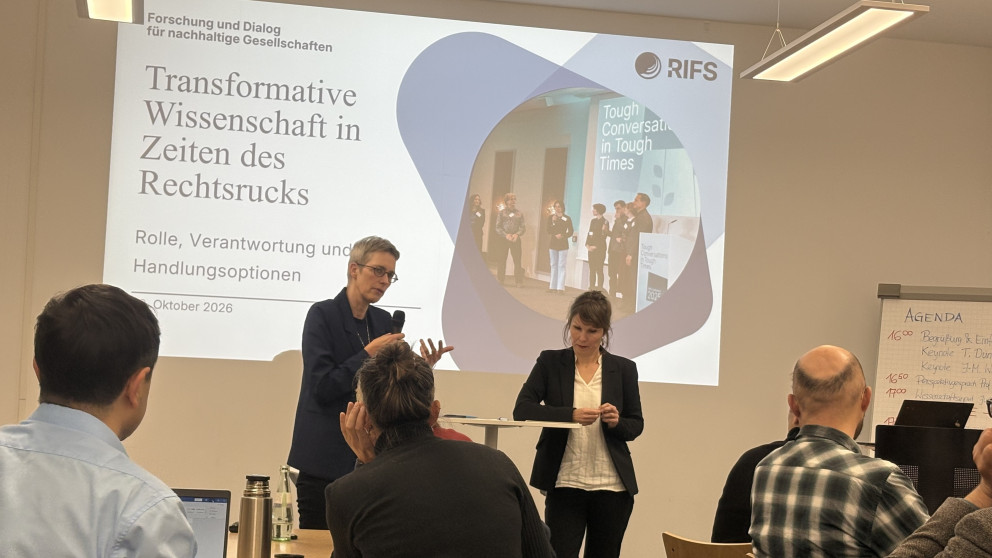
Three perspectives from politics, the media and research
“Academic freedom is a cornerstone of our democracy, as it enables independent inquiry and critical debate,” says RIFS Director Doris Fuchs, explaining the background to and motivation for the dialogue forum. “An increasingly hostile atmosphere towards researchers and their findings is putting this freedom at risk, particularly for sustainability research.”
The forum began with statements from Tobias Dünow, State Secretary at the Brandenburg Ministry of Science, Research and Culture; science journalist Jan-Martin Wiarda; and Susanne Buiter, Scientific Executive Director of the GFZ Helmholtz Centre for Geosciences.
Tobias Dünow described the defence of academic freedom as a central task of science policy, arguing that a free society is impossible without free science. Enemies of science, he said, dismiss scientific facts as mere opinions, and policymakers must push back against this. “Science and politics depend on each other in many ways,” said Dünow. “At the same time, they follow very different logics and derive their legitimacy in entirely different ways. Politics must not replace science. Nor must science replace politics.”
Jan-Martin Wiarda described how right-wing populism influences politics and society even without changing laws or cutting funding. The success of right-wing populist parties, he said, is shifting the discourse across the political spectrum. Paradoxically, the Alternative for Germany (AfD) attacks academic freedom in the name of ‘academic freedom’ and calls for ‘apolitical science’. That demand, he said, is itself “highly political”. Because sustainability research questions the consequences of the way we live, it must remain politically uncomfortable while staying open to dialogue.
Dünow and Wiarda both called on sustainability researchers to remain open to other perspectives. The political course, they said, is set by the majority as expressed in elections, and this calls for new responses.
Susanne Buiter said it was a major strength that policymakers in Brandenburg stand behind research. But that alone is not enough: solidarity is also needed, both with researchers and between institutions. The recent joint statement ‘Free science strengthens Brandenburg’ is important, she said, but needs to be put into practice. Within the Helmholtz Association, the debate on resilience has gained momentum with the creation of a Strategic Unit for Security and Resilience Research. Buiter also noted that, as part of the Helmholtz Association, the GFZ acts as a shield to protect sustainability research at RIFS.
Four thematic roundtables
After the three talks, participants split into smaller thematic groups to discuss academic freedom and funding; the sustainability research agenda in times of backlash; diversity and the protection of vulnerable groups; and the role of transformative and transdisciplinary research. Participants found the exchange extremely fruitful, particularly because it reached across institutional boundaries, and are keen to continue it.
“What came through clearly at our dialogue forum is how much current political developments concern sustainability researchers. Academic freedom is indispensable if we are to work out how to build an ecologically sustainable and socially just future,” said Franziska Mey, who leads the research group Democratic Governance and Agency at RIFS. “However, to achieve this, we must also take a self-critical look at our own role and responsibilities.”
Discussion paper: “Backlash to Sustainability Transformations”
One insight ran through all the discussions at the forum: the backlash against sustainability transformations is closely intertwined with questions of justice, societal polarization and far-right mobilization. To coincide with the forum, RIFS published a Discussion Paper on these questions, calling for a research agenda that engages critically with the challenges posed by the backlash.
Publication: Plessing, J., Bersalli, G., & Mey, F. (2026). Backlash to Sustainability Transformations: Implications, Strategies and the Role of Research. RIFS Discussion Paper, October 2026.