Site Finder Helps Identify Suitable Sites for Wind and Solar Power
05.10.2026
Where in Germany are the conditions favourable for wind turbines and ground-mounted photovoltaic systems? What legal, technical and environmental aspects need to be considered? The Renewable Energy Site Finder (EE-Standortfinder) provides answers to these questions. This interactive and freely accessible web application, developed by the Helmholtz Centre for Environmental Research (UFZ) together with the Research Institute for Sustainability at the GFZ (RIFS), shows potential sites and their suitability on an interactive map of Germany, highlights possible trade-offs, and provides information on financial contributions to municipalities available under national and state legislation on revenue sharing.
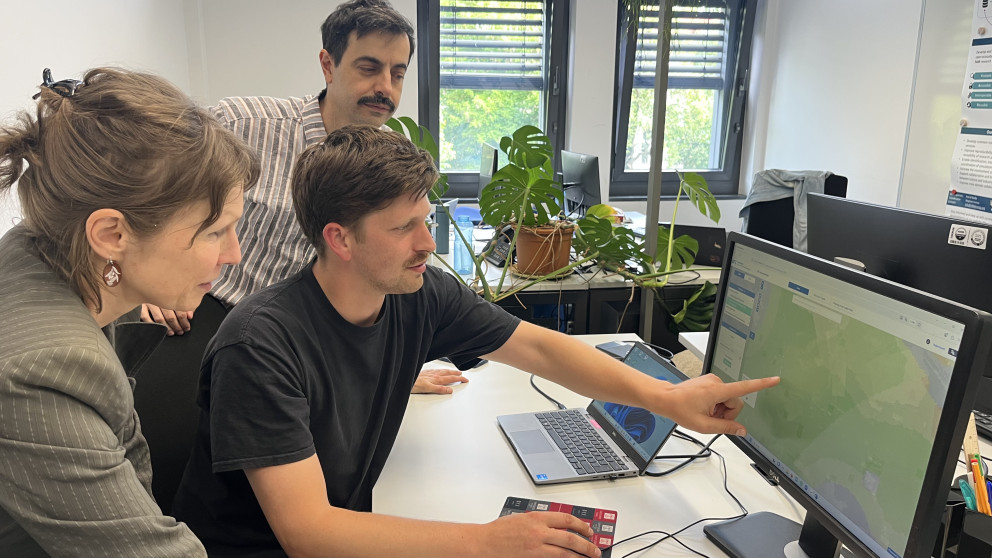
The build-out of renewable energy requires suitable land. However, finding such sites is challenging, as different interests, land-use constraints, and technical considerations come into play. “Although much of the information relevant to site selection already exists as spatial data, it comes from different sources and is often very time-consuming for people without in-depth GIS knowledge to analyse,” says project lead Nora Mittelstädt from the UFZ. The web application processes the relevant information so that site potential and possible conflicts of interest become apparent at an early stage.
More than 60 assessment criteria
The Renewable Energy Site Finder uses a colour scale on an interactive map of Germany to indicate how well potential sites are suited to wind turbines and ground-mounted photovoltaic installations, summarizing its findings clearly. For the assessment of potential wind power sites, 54 assessment criteria are taken into account. These include vegetation, protected areas, built-up and water areas, transport infrastructure, and collision risks for breeding birds such as the red kite, eagle owl and white-tailed eagle. The Renewable Energy Site Finder integrates the Biodiversity Area Indicator, developed by the Leibniz Institute for Ecological Spatial Development, which assesses the quality and diversity of biotope types as habitats for various species.
The potential of ground-mounted PV is assessed on the basis of 42 criteria. These include not only standard criteria such as vegetation, protected area categories, settlement and water areas, or transport infrastructure, but also, for example, an assessment of the agricultural yield potential of the soil and the potential revenue for local authorities from the installations under financial participation legislation.
The tool is aimed, among others, at local authorities, energy agencies and consultancy firms, stakeholders in spatial and regional planning, project developers, and the interested public.
Easy access to information
A key strength of the tool lies not only in identifying suitable sites, but also in fostering informed local debate about potential locations. Franziska Mey, project lead at RIFS, emphasizes: “The Renewable Energy Site Finder offers free and easy access to an extensive database that has until now largely been available only to project developers. It can therefore help to reduce information asymmetries and, especially in controversial local debates, support a more objective discussion about potential sites."
Lukas Meese, a project team member at RIFS, adds: "The Renewable Energy Site Finder highlights the local economic potential and immediately indicates the financial contributions local authorities could receive under current legislation on revenue sharing."
In this way, the tool creates transparency in the site selection process and can support informed discussion on the expansion of wind farms and ground-mounted solar installations.
The project was funded by the Federal Ministry for Economic Affairs and Energy and carried out by the Helmholtz Centre for Environmental Research GmbH (UFZ) and the Research Institute for Sustainability at the GFZ (RIFS).
- Renewable Energy Site Finder (EE-Standortfinder): https://web.app.ufz.de/gdi/ee-standortfinder
- Direct questions and suggestions to: ee-monitor [at] ufz [dot] de (ee-monitor[at]ufz[dot]de)
- Further information on the environmental sustainability of the energy transition in Germany can be found at https://ee-monitor.de
Contact