Cooperative Economies for Resilient Urban Development: Examples from France, Lessons for Germany
23.07.2026
As cities face intensifying environmental and social challenges, resilient infrastructure is key to safeguarding local supply chains, circular economies, essential social services, and climate adaptation efforts. RIFS Discussion Paper “Dare to Design for Disaster: Cooperative Economies for Resilient Urban Development” offers new perspectives on driving social and ecological transformation in urban areas. By examining case studies from Germany and France, the paper highlights the significant potential of cooperative approaches.
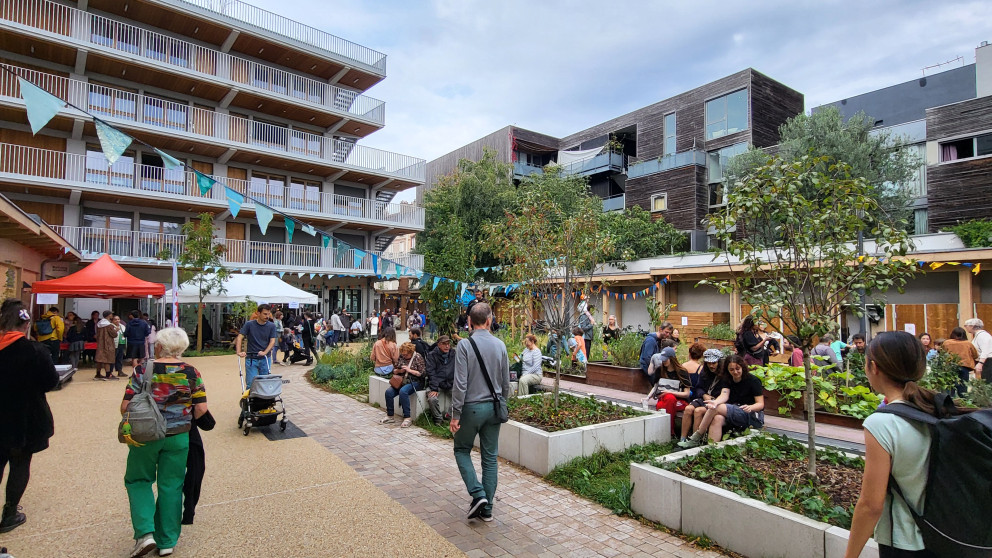
In their publication, Cléo Mieulet (Research Institute for Sustainability) and Paul Jerchel (Institute for Corporate Democracy) explore the benefits of the Social and Solidarity Economy (SSE). This democratic model of economic organisation is defined by collective decision-making, shared ownership, and a commitment to generating social value. Unlike traditional approaches centred on competition and profit maximisation, the SSE connects economic activity with efforts to achieve social, environmental, and local development goals, while also fostering democratic participation.
Examples from France demonstrate how state support, cooperative organisational models, and active civil society participation can contribute to the development of resilient local infrastructure. These include locally supported food systems, initiatives to address long-term unemployment, innovative approaches to reuse and repair, and mechanisms for activating vacant properties and supporting community-led urban development. A key factor in their success is the existence of legal and institutional frameworks that enable experimentation, support innovation, and help embed effective practices over the long term.
While cooperative economies are increasingly recognised as an important component of public infrastructure policy in France, comparable approaches in Germany remain fragmented and often confined to isolated projects. Consequently, the authors call for a more systematic approach, arguing that the cooperative sector should be recognized as a distinct, relevant economic pillar and supported through stable, long-term investment. Key recommendations include providing reliable infrastructure funding rather than short-term project-based financing, improving access to land and capital, and creating regulatory frameworks that facilitate cooperation. Furthermore, the authors emphasize the importance of scaling successful models and strengthening networks to enable knowledge exchange. They also advocate for creating new spaces for experimentation and providing targeted support for community-led, socially oriented economic initiatives.
The publication concludes that resilient cities are not created through individual model projects, but through long-term, collaboratively organised infrastructure. Central to this is a recognised partnership between the state, civil society, and cooperative actors, working together on an equal footing.
Mieulet, C., Jerchel, P. (2026): Dare to Design for Disaster: Cooperative Economies for Resilient Urban Development. - RIFS Discussion Paper, July 2026.
https://doi.org/10.48481/rifs.2026.020
Contact