Amazon: Study Examines Planetary Governance by Carbon Metrics
06.11.2026
A study by the Research Institute for Sustainability at the GFZ (RIFS) shows that the Amazon rainforest is increasingly seen as a region crucial to planetary agenda for climate policy. In the study, Maria Cecilia Oliveira examines how international financial flows and digital monitoring systems are establishing a new form of governance that defines the forest primarily as a global carbon sink while pushing local realities into the background.
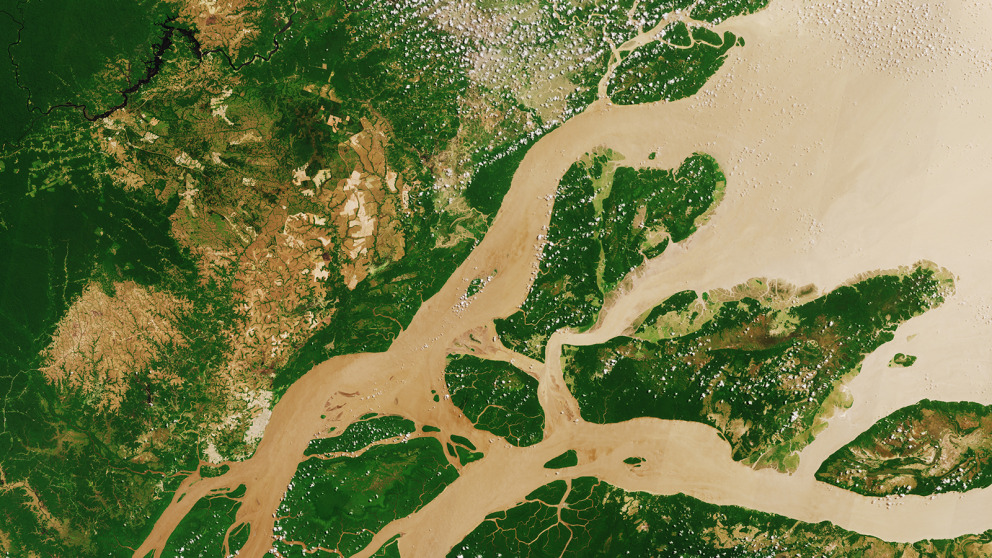
In her analysis, published in a special issue for Global Environmental Politics, Oliveira, a research group leader at RIFS, describes a shift in the governance of the Amazon: the region, once viewed as the sovereign territory of the Amazon countries and a source of resources, is now seen as a central element in planetary climate and resource governance. This, she argues, has given rise to a ‘transterritorial space’: one shaped by forces that cut across national borders and political domains.
In such a space, power no longer operates only within national borders but through transnational flows of capital, data and scientific indicators. “The risk here is that the Amazon rainforest comes to be seen as nothing more than a carbon reservoir,” says Oliveira. “The socio-ecological realities of the people who live there become invisible, while existing power structures are cemented under the guise of climate protection.”
According to the study, the entire biosphere is subjected to a uniform apparatus of surveillance and management. Within this system, the forest’s value is measured primarily in terms of its role in the global climate system, above all its capacity to sequester carbon. This view, Oliveira argues, ends up defining the forest as a ‘body’ for regulating the global climate.
Reducing the forest to carbon data
Oliveira argues that current climate governance reduces complex socio-ecological realities to quantifiable metrics. “Within this framework, local knowledge and millennia-old forest management practices are legitimized only if they can be translated into the dominant discourse on climate change,” she says. Yet archaeological evidence, such as fertile terra preta soils, artificial settlement mounds and raised causeways stretching for kilometres, shows that the region’s biodiversity is in part the result of long-term human intervention. These findings run counter to the image of the Amazon as a pristine resource untouched by humans.
Oliveira links this reduction of the forest to a historical ‘plantation logic’: as in earlier extractive systems, land is now managed according to global parameters. Treating the forest as a mathematical carbon reservoir risks making the people who live on and care for the land invisible in the data. This allows economic actors to label territories as ‘sustainable’ through offsetting mechanisms without addressing the underlying land-use conflicts or the rights of Indigenous communities.
Instruments of planetary governance
To analyse the dynamics and effects of this transterritorial space, the study examines three key domains: diplomacy, finance and science.
- Diplomatic frameworks such as the Belém Declaration often function as non-binding guidelines aligned with global agendas.
- Financial instruments such as the Amazon Fund focus on the forest’s global benefits, while local supply chains and economies are often overlooked.
- Scientific infrastructures, in particular satellite monitoring systems, render the forest visible worldwide in real time. The study does not regard this transparency as a neutral process but as a practice that legitimizes particular truth claims about the territory’s value.
The analysis concludes that planetary governmentality acts as an additional layer of control. It operates alongside the state power of the Amazon countries and uses it to enforce international climate metrics set by institutions such as the EU and the UN for the protection of biodiversity. As a transterritorial space, the Amazon region mobilizes productive, interventionist and technocratic forces on the one hand, while restricting the potential for resistance on the other.
Methodology
The study is a theoretical analysis drawing on Michel Foucault’s concept of governmentality and Edson Passetti’s theory of ecopolitics. Oliveira examined diplomatic documents, transnational financial flows and the structure of scientific knowledge infrastructures to analyse the mechanisms of territorial transformation in the Amazon region.
Publication: M. Cecilia Oliveira: Remaking the Amazon? The Emergence of Transterritorial Spaces of Governmentality. Global Environmental Politics 2026; 26 (3): 157–166. DOI:10.1162/GLEP.a.786