Sustainability Policy Under Pressure: Can Science Act as a Bridge-Builder in Divided Times?
09.09.2026

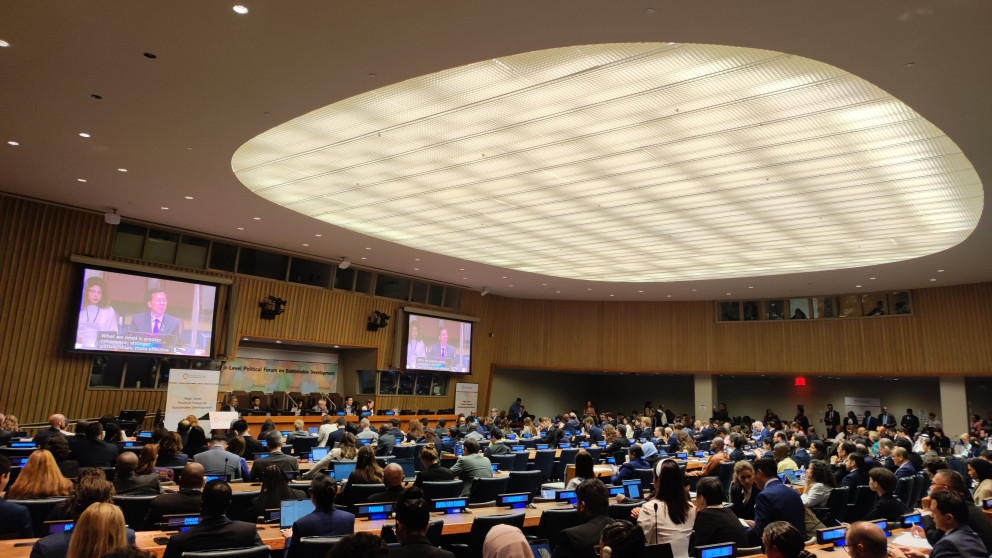
The Sustainable Development Goals (SDGs) are among the few issues on which the international community is fundamentally in agreement, at least on paper – or so it seemed in the past. The 2030 Agenda for Sustainable Development was adopted by the United Nations in 2015. However, the High-Level Political Forum (HLPF) on the implementation of the SDGs, which took place in July at the United Nations in New York, revealed an ever-widening gap between resolutions and implementation. In addition, the negotiation processes for the post-2030 period have not yet been officially launched.
These challenges do not stem solely from a lack of knowledge. They are also a problem of understanding political processes. And this is where a key player comes into the picture, one that is often underestimated in public debate: the scientific community. Not merely as a provider of facts and expert reports that assess progress in implementation, but as a supporter capable of mediating between political levels and particular interests. Transdisciplinary research, in particular, serves as a trailblazer that can initiate political processes by giving a voice to interests that are not, or not sufficiently, represented – such as the environment and future generations.
Global, national, local – three levels and their challenges
A political divide runs between the levels of implementation. Agendas are negotiated somewhere in the world, translated into national strategies in Berlin, and must ultimately be put into practice in a municipality in Saxony, a district in Bavaria or a small village in North Rhine-Westphalia. At the same time, specific challenges arise at each of these three levels.
The global level operates in terms of overarching objectives that are negotiated internationally, along with associated indicators and reporting obligations. Now more than ever, it must reconcile national geopolitical and economic interests and capacities if it is to have a chance of ensuring that the negotiated treaties amount to more than mere rhetoric.
At the national level, in the best-case scenario, global frameworks are translated into legislation and funding programmes. However, effective implementation must mediate tensions between influential interests and societal perspectives, conflicts that are exploited by populists and fuelled by the media. Currently, national security interests, economic growth and competitiveness loom large on government agendas. Integrative frameworks such as national sustainability strategies are not utilised sufficiently as a basis for negotiating conflicting objectives between particular interests.
At the local level, specific distributional issues arise, for example, in the form of land-use conflicts. Here, the political competition for acceptance becomes particularly evident. At the same time, opportunities for action sometimes emerge in exactly those contexts that are beyond the direct constraints of international politics and the global economy.
Finally, at all levels, there is a conflict between (short-term) political and economic priorities and the (long-term) protection of the ecological foundations – for present and future generations. Distributive issues play a central role here, with both ecological crises and the stalled progress of the 2030 Agenda rooted in socio-economic and political inequalities.
Science as a bridge-builder
This makes it all the more important to have organisations that understand the processes and challenges at different levels and between different stakeholders, and that can support efforts to address them. The scientific community can play an important role in bridging these gaps. Not only can it supply the current state of scientific knowledge as a reality check within political processes, but it can also help to bring the various interests and perspectives to light. Furthermore, transdisciplinary research can help to develop shared problem definitions and potential solutions collaboratively with all affected stakeholders, thereby paving the way for the successful negotiation and implementation of agreed objectives.
However, scientific structures are often ill-equipped to facilitate this kind of translation. The processes are resource-heavy and require not only extensive interdisciplinary but also transdisciplinary process expertise. At the same time, this work usually does not result in what, from a traditional scientific perspective, earns the accolades of ‘excellence’. Nor are the contexts often yet open to this work of translation and mediation. In political arenas, the stringing together of statements still predominates, leaving no room for genuine exchange or for developing a shared understanding of problems and solutions.
However, there has also been progress in the scientific and political recognition of the value of transdisciplinary research, as well as windows of opportunity that can and must be seized in order to achieve the sustainability goals set at a political level. The German delegation to the HLPF facilitated dialogue between political (including parliamentarians and actors from public administration), economic, civil society and scientific actors and, by involving local government actors in particular, enabled exchange between different levels of governance. Scientific work in the context of international negotiations, national dialogues, as well as in model regions and living labs, facilitates the necessary co-creative collaboration with different stakeholders at different levels and acts as a bridge between them. A multi-level presence and transdisciplinary expertise are not by-products of these processes; they are specific and indispensable scientific competencies. By understanding, for example, why local communities resist certain conservation measures, researchers can help shape more effective and realistic global objectives – and, conversely, seemingly abstract global targets can be translated into practical measures in collaboration with local stakeholders.
Building bridges means taking this act of translation seriously
What links the three levels is a shared blind spot: the assumption that good policy requires, above all, sound knowledge. That is true – but it is not enough. Good policy requires knowledge that is available at the right time, at the right level and in the right format, and that is brought into these processes with political awareness, patience, persuasiveness and intuition. This is precisely a task of translation, not merely one of insight.
Effective bridging requires more than the goodwill of the actors involved. It requires formats that involve the academic community in these processes, and it requires academics who are prepared to move beyond working in parallel toward integrated, inter- and transdisciplinary collaboration.
This mediating competence can be applied to many other political processes; however it requires a deep understanding of the underlying conflicts. The success of global agendas, such as the 2030 Agenda, does not hinge on a lack of knowledge, but rather on the ability to bridge the gap between expertise and action. If these agendas fail, it will be because we failed to build the bridges required to bring knowledge and transdisciplinary expertise to where it is needed most.