Navigating Sustainable Hydrogen Governance - Insights from a RIFS Webinar
20.04.2026



On April 15th, 2026, the Research Institute for Sustainability (RIFS) at GFZ Helmholtz Centre for Geosciences and the Heinrich Böll Foundation hosted a webinar to discuss actionable recommendations in support of a rapid and sustainable hydrogen ramp-up. The event centered on the presentation of a new RIFS Policy Paper entitled "Strengthening Sustainability Governance for a Rapid Hydrogen Ramp-Up," which provides recommendations for European decision-makers to navigate environmental and social risks while accelerating the development of a hydrogen economy. The policy paper builds on a series of studies developed in the context of the RIFS project “Geopolitics of the Energy Transformation: Sustainability Governance in the Hydrogen Sector (GET Sustainable Hydrogen)”, funded by the German Federal Foreign Office.
Geopolitical urgency and the role of hydrogen
The webinar opened with introductory remarks from Meik Laufer (German Federal Foreign Office), who underscored the heightened geopolitical importance of hydrogen. In light of the full-scale invasion of Ukraine and major military confrontation in the Middle East, he emphasized that hydrogen is no longer just a climate tool but a cornerstone of energy security and foreign policy. He also noted that energy, foreign, and climate policies are now inextricably linked, making the development of a competitive, sustainable market more urgent than ever.
Strengthening sustainability governance for hydrogen
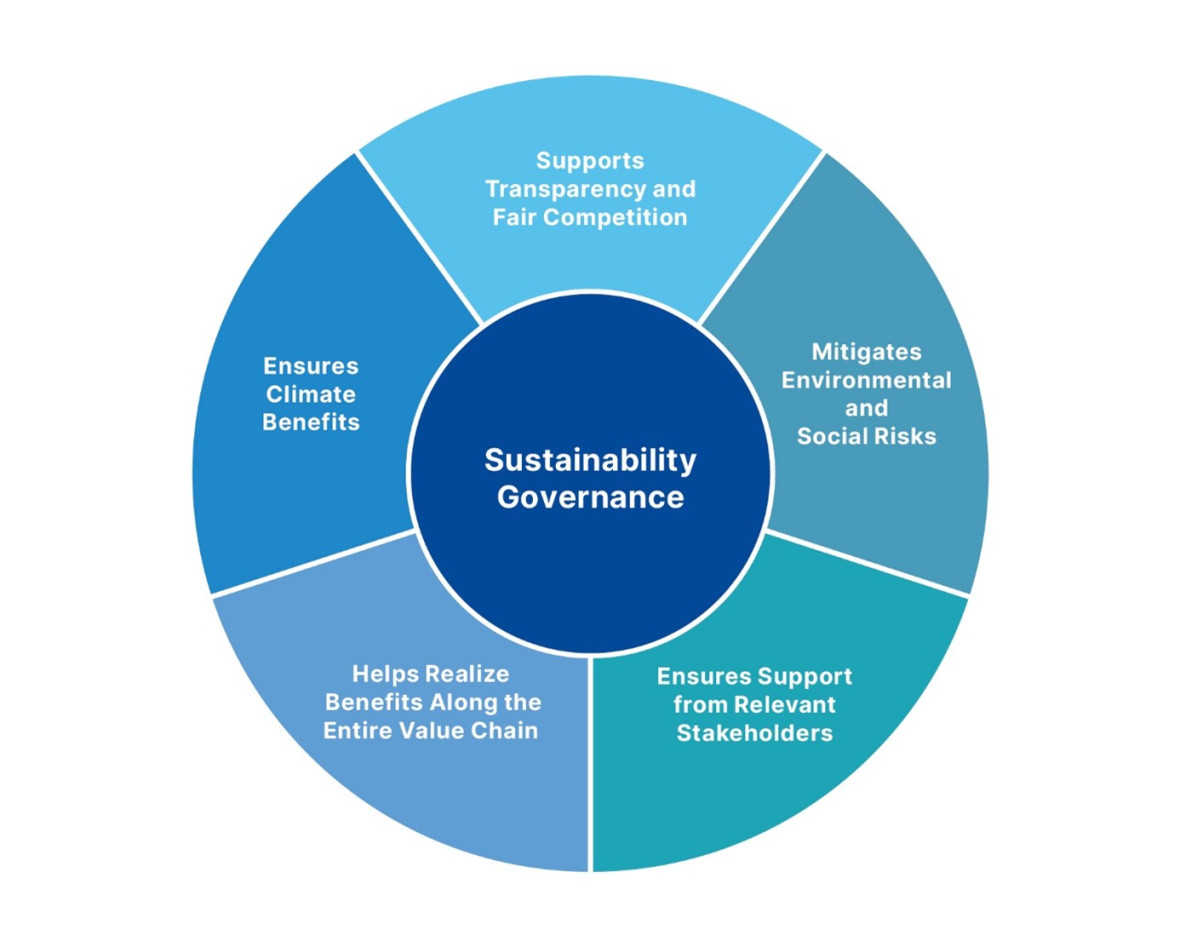
Maximilian Rischer (RIFS) presented the core findings of the policy paper. He started by highlighting the importance of robust sustainability governance for the development of the hydrogen sector. He highlighted its various contributions, from ensuring climate benefits and mitigating environmental and social risks of hydrogen to fostering transparency and realizing benefits for stakeholders throughout the value chain (see figure below).
He then presented recommendations for strengthening sustainability governance in the hydrogen sector. These build on the premise that the EU already has a robust set of governance frameworks to support sustainability in place (see RIFS Study Governance for a Sustainable Hydrogen Economy: A Review of the Current State of Play for a comprehensive overview). Accordingly, the focus can now shift toward streamlined implementation - adapting, refining, and strengthening existing mechanisms to better address the specificities of hydrogen. To achieve this, the paper proposes four key recommendations:
- Hydrogen-Specific Due Diligence Guidelines: Multilateral development banks should develop common hydrogen-specific guidelines to help companies manage social and environmental risks as part of their due diligence processes. These guidelines can strengthen sustainability while facilitating access to finance by supporting compliance with existing requirements from financial institutions.
- ISO Standard for Sustainability: The International Organization for Standardization (ISO) should develop a standard to support harmonization of sustainability assessments for hydrogen and its derivatives and promote consistency across global markets.
- Best Practice and Capacity Building: Donors should continue their support for international initiatives like the International PtX Hub or UNIDO’s Global Programme for Hydrogen in Industry to share knowledge and best practices, help project developers understand and meet sustainability requirements cost-effectively, and support capacity development across the sector.
- Robust Certification Systems: Heeding lessons from the bioenergy sector, the EU should ensure rigorous oversight of regulatory requirements and related certification schemes, e.g. via the EU’s Union Database, to prevent fraud and ensure a level playing field for all market participants.
Perspectives from the hydrogen sector
Following the presentation, a panel of experts shared their views on the practicalities and challenges of this transition:
- Jan Klenke (H2Global Foundation) stressed the need for alignment across different governance mechanisms to ensure market efficiency.
- Marion Malafosse (DG ENER, European Commission) highlighted that robust certification, notably through the voluntary schemes are central for credibility and traceability. She noted that the Commission is working to finalize the Union Database to prevent the type of irregularities previously seen in the biofuels sector.
- Stanislave Demeestere (Hydrogen Europe) pointed out the vital role of Member States in implementing European legislation. He raised the challenge of aligning standards across diverse jurisdictions and noted that hydrogen is key to reducing supply chain dependencies, suggesting that Europe should remain the pioneer for ambitious climate-related requirements.
- Neelke Wagner (PowerShift e.V.) reminded the audience that human rights protections must be cross-sectoral to ensure a level playing field between new, climate-friendly energy carriers like hydrogen and existing fossil-based energy sources. She advocated for hydrogen production in exporting regions to be tied to local electricity transitions, ensuring that the same rules applied in Europe also govern imports. She also cautioned that the scale of projects must be carefully managed to avoid land-use conflicts.
Closing remarks: From project-level due diligence to green industrial strategy
In his concluding remarks, moderator and RIFS research group leader Rainer Quitzow emphasized that the sustainability requirements being set for hydrogen should also be applied to other energy carriers, in particular fossil fuels. For this, he argued for ensuring the robust implementation of generic instruments like the Corporate Sustainability Due Diligence Directive (CSDDD). He further noted that ensuring local value creation in potential producer or exporting countries cannot be addressed primarily at the project-level. Hence, due-diligence requirements alone are not sufficient to ensure benefits accrue throughout the value chain. Rather, green industrial policies, supported by high-level strategic dialogues involving governments, development banks, industry and civil society, is needed to ensure a "win-win" outcome for all parties involved.
Links:
- Download RIFS Policy Paper: https://doi.org/10.48481/rifs.2026.006
- Download RIFS Study: https://doi.org/10.48481/rifs.2026.002
- Recording of the webinar: https://www.youtube.com/watch?v=IX_M9hptizk
- More Information on the project and links to additional publications (please scroll down to the bottom of the page): https://www.rifs-potsdam.de/en/research/geopolitics-energy-transformati…
Media
Recording of the webinar "Navigating Sustainable Hydrogen in Times of Uncertainty"