Weaving new narratives for transdisciplinary sustainability research
17.12.2025

This post was co-authored by Felix Beyers, Philip Bernert, Karoline Augenstein, Viola Hakkarainen & Andra Horcea-Milcu
Transdisciplinary sustainability research has grown rapidly over the last decade. It is now widely seen as a key approach to addressing the intertwined ecological, social, and political crises we face today. At the same time, many researchers experience that working transdisciplinarily has become more demanding, more politicised, and more emotionally intense. In times of polycrisis, shrinking democratic spaces, and growing pressure to demonstrate “impact”, two important questions arise:
What does it mean to do transdisciplinary research in tough times? And which narratives guide our work, often implicitly, shaping what is possible, visible, and valued?
This challenge was at the heart of the 2025 RIFS Conference “Tough Conversations in Tough Times”, where we convened an interactive session titled “Weaving New Narratives: A Generative Space for Reflecting and Practising Transdisciplinary Sustainability Research.” The session responded to a growing sense within the field that transdisciplinary research is being asked not only to innovate, but also to offer guidance by co-creating grounding narratives with others in the field and cultivating relational spaces in which collective understanding and future directions can emerge.
This blog post is part of a series on the RIFS Conference 2025, "Tough Conversations in Tough Times".
The session created space to surface and reflect on these dynamics. Through a world café format, participants engaged with the four lenses of Being, Thinking, Doing, and Narrating transdisciplinarity, drawing inspiration from the forthcoming “Handbook on Transdisciplinary Sustainability Research: Co-Creating New Narratives”. Moving between these dimensions allowed participants to articulate everyday ethical and political dilemmas, boundary work, and emerging possibilities for the field. Building on these collective reflections, we invite contributions and propose the handbook as a shared platform to make such often-unspoken dimensions of transdisciplinary research visible and to co-create new narratives for sustainability research in times of crisis.
Being Transdisciplinary: Identity, Purpose, and Care
Transdisciplinary sustainability research is deeply personal and relational work. It involves inhabiting multiple roles, switching between being an academic, a facilitator, a learner, or a mediator, while continuously negotiating values, expectations, and responsibilities across shifting institutional contexts. Participants of our workshop shared moments when this work felt particularly meaningful, such as when new languages for collaboration emerged or when projects created unexpected spaces for care, recognition, and connection. However, many also voiced the exhaustion linked to emotional and ethical labour that remains largely invisible in scientific discourse.
Discussions at the Being table highlighted the fluidity of researcher identities, with reflections clustering around positionality, intuition, and the tension between ambition and humility. Participants described transdisciplinarity as working with “blurred edges,” where trust, both practiced and embodied, forms the relational foundation for collaboration across differences.
A recurring theme concerned boundaries and self-care, including the need to set limits. This surfaced the often-unspoken emotional work of transdisciplinarity. Reflections on “footprint, handprint, and heartprint” capture how researchers leave traces not only through publications or policy advice, but through relationships, processes, and the spaces they help create. A persistent question underpins many conversations on transdisciplinary research: Why do we do this work? In institutional settings focused on outputs, excellence, and competition, this question can easily get lost or overshadowed.
Thinking Transdisciplinarily: Epistemologies, Power, and Sensemaking
The Thinking dimension focused on the epistemic foundations of transdisciplinary sustainability research: how researchers make sense of complexity, what forms of knowledge are recognised, and whose perspectives shape problem framings and solutions. Participants emphasised that thinking transdisciplinarily is not only an analytical task but a political and relational one that extends from understanding interdisciplinary dynamics to the critical questions of inclusion and exclusion and the type of leadership needed.
Discussions at the Thinking table revealed a dense constellation of concepts, epistemologies, ontologies, paradigms, and worldviews, interwoven with practices of reflexivity, transparency, and critical self-reflection. Participants highlighted the need to hold multiple elements in productive tension: systems thinking and relationality, normativity and values, complexity and power. Some participants humorously referred to scientists as “nerds,” while seriously questioning whether academics are allowed, or encouraged, to step outside this role. Thinking was understood as both an individual and collective process, shaped by learning structures and the architectures of knowledge production, not only by theories and frameworks.
Participants identified key epistemic tensions, including navigating plural epistemologies, balancing rigour and relevance, and negotiating legitimacy across academic and policy arenas. While foundational transdisciplinary theories remain important, many called for renewed conceptual work that better reflects contemporary political, ecological, and institutional conditions. Thinking transdisciplinarily thus requires epistemic humility, critical awareness of power in knowledge production, and an understanding of theory as a living resource that evolves with practice and context.
Doing Transdisciplinarity: Practices, Tensions, and Transformative Potentials
Doing transdisciplinary research means working in contested, unpredictable, and relationally dense environments. The world café conversations surfaced both practical challenges and enabling conditions. Although participants discussed concrete methods, like design thinking and experimental approaches, they stressed that transdisciplinary practice is about much more than tools. Methods were seen as shaping who is included or excluded, and truly transdisciplinary work was often understood as depending less on formal toolkits than on time, relationships, and informal contact.
Participants emphasised the importance of “in-between spaces”: unstructured moments, openness, and informal encounters as key conditions for meaningful collaboration. Practical supports such as transdisciplinary interface managers, intermediary roles, buddy systems, and practice-oriented learning were highlighted as important bridges between disciplines and societal actors.
The conversation then shifted to deeper questions. Doing transdisciplinarity was described not only as active engagement, but sometimes also as “not doing” or “undoing”, unlearning disciplinary habits and challenging forms of socialisation within the science system that reward excellence, neutrality, and competition over care, solidarity, and humanity.
Finally, participants critically discussed academic structures that hinder transdisciplinarity. Power and hegemonic norms were identified as shaping what is possible, with institutions functioning both as constraints and, at times, as sources of security. Doing transdisciplinarity often involves finding “hacks”: small acts of resistance, creative side paths, and informal strategies that make transdisciplinary work possible within, and in attempts to transform, the system itself.
Narrating Transdisciplinarity: Stories That Shape Futures
The Narrating dimension invited participants to reflect on the stories that shape transdisciplinary sustainability research and those still missing. Participants emphasised that the field is held together by narratives: stories of origins and impact, but increasingly also of struggle, care, and renewal. Many of these remain unspoken, particularly when they challenge dominant success narratives or institutional expectations.
Narrating transdisciplinarity therefore emerged not merely as a descriptive practice, but as actively shaping futures for the field. Narratives influence what is seen as legitimate, fundable, and worth sustaining, and whose experiences remain invisible. They require collective reflection, plurality, and dialogue across experiences and positions.
Cross-Cutting Insights: Boundary Work, Trust, and Coherence
Across the world café conversations, several integrative themes connected Being, Thinking, and Doing transdisciplinarity. Together, they highlight that while transdisciplinary sustainability research is increasingly invoked in response to political, ecological, and societal crises, there is still limited shared reflection on the narratives through which the field explains its role, responsibilities, and possibilities.
Boundary work emerged as a unifying thread, appearing as conceptual boundaries in Thinking, identity boundaries in Being, and practical interfaces in Doing. Rather than resolving tensions, participants emphasised the importance of working at edges and sustaining productive ambiguity.
Trust surfaced as another recurring theme: something to embody, to critically reflect upon, and to actively enact. Its presence across all dimensions underscores that trust is not a fixed precondition, but an ongoing and fragile achievement of transdisciplinary work.
Power and positionality cut across discussions, shaping epistemic framings, researcher identities, and collaborative practices. Participants stressed that thinking, feeling, positioning, and acting in transdisciplinary research are deeply interconnected and cannot be understood in isolation. Reflexivity therefore emerged as a core competence, not only as a methodological requirement, but as a narrative practice that makes assumptions, values, and exclusions visible.
Finally, attention to spaces and infrastructures, linking learning architectures (Thinking), relational traces such as footprint, handprint, and heartprint (Being), and labs or other containers as sites of practice (Doing), reinforced that transdisciplinarity does not operate in abstraction. It depends on intentionally designed spaces capable of holding complexity, uncertainty, and difference.
Taken together, these insights point to the need for more explicit, collective reflection on the narratives that currently shape transdisciplinary sustainability research–a reflection we seek to continue through the Handbook on Transdisciplinary Sustainability Research: Co-Creating New Narratives.
Call for Contributions
We invite contributions to the upcoming Handbook on Transdisciplinary Sustainability Research: Co-Creating New Narratives (Edward Elgar Publishing), which will map current practices and emerging directions in transdisciplinary sustainability research while advancing new narratives for the field. As transdisciplinary research becomes increasingly established, it continues to evolve in response to deepening socio-ecological crises and societal fragmentation. This volume asks:
What is the role of transdisciplinary sustainability research today, and how can it be practiced in more generative, inclusive, and transformative ways?
We welcome honest, reflexive, and creative contributions that engage with lived experiences, tensions, and possibilities of transdisciplinary work across contexts and geographies. Submissions may take diverse forms, including essays, reflective pieces, dialogues, field reports, arts-based contributions, and method-centred narratives. Contributions that challenge conventional academic formats and make visible the emotional, ethical, and political dimensions of transdisciplinary research are especially encouraged.
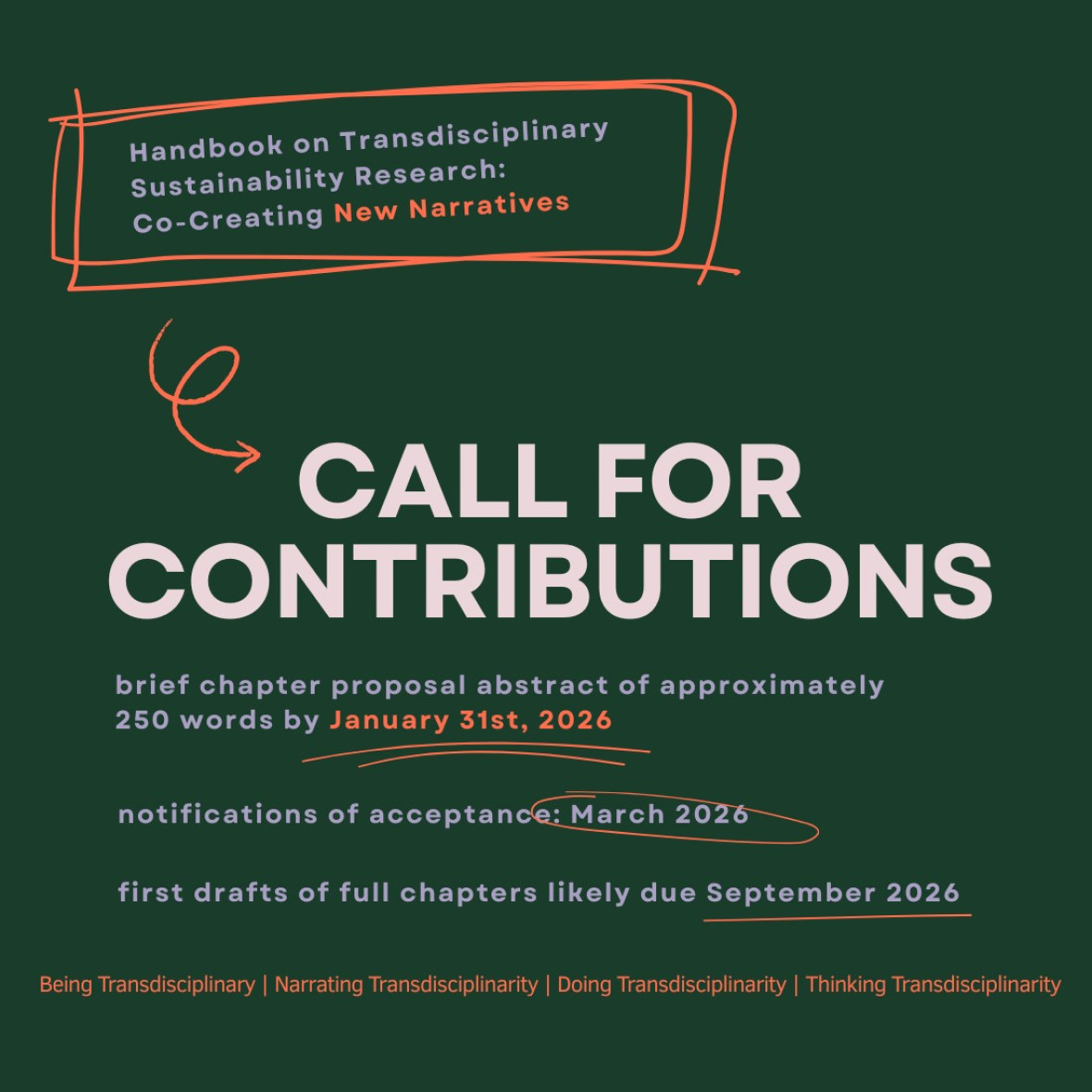
If this book resonates with you and you feel inspired to contribute, we warmly invite you to share a brief chapter proposal abstract (around 250 words) with us by 31 January 2026 at td [at] uni-kassel [dot] de (td[at]uni-kassel[dot]de)
Submission Guidelines & Timeline
- Chapter proposal (250 words): 31 January 2025
- Submit to: td [at] uni-kassel [dot] de (td[at]uni-kassel[dot]de)
- Notifications of acceptance: March 2026
- Full chapter drafts: November 2026
- Peer feedback & editorial guidance: Ongoing through early 2027
- Final chapters: September 2027
(Timelines may be refined in consultation with the publisher.)
Editors
- Karoline Augenstein – Junior Professor for Policy Analysis & Transformation, University of Wuppertal / TransZent
- Philip Bernert – Research Associate in Transdisciplinary & Transformative Sustainability Research, RIFS at GFZ
- Felix Beyers – Research Associate on Transformative Spaces and Mindsets, RIFS at GFZ
- Viola Hakkarainen – Substitute Professor for Transdisciplinarity for Sustainability Transformation, Leuphana University
- Andra-Ioana Horcea-Milcu – Professor; ERC Project Lead (Lever); Lead Author, IPBES Transformative Change Assessment; Co-Director, Kassel Institute for Sustainability
We look forward to co-creating new narratives for the future of transdisciplinary sustainability research together.