Space as an Arena for Interaction – From the Theatre to Transformation Research
15.05.2026
Scenographer and research artist Janina Janke will be bringing her expertise to RIFS during her fellowship, helping to shape spaces for transformative processes and dialogue-driven formats. With over twenty years’ experience in theatre, specializing in site-specific projects and interactive formats, she has a deep understanding of how spaces impact social interaction. During her fellowship, she will explore how spaces can either enable or hinder encounters between people from different backgrounds and with different viewpoints.
Janke’s artistic journey spans set design, spatial installations, urban practice, and the humanities, philosophy and ethnology. Her diploma in scenography from the University of the Arts Berlin marked the beginning of an intensive exploration of urban spaces and their transformation. Projects such as her investigation of Zoologischer Garten station, the former main station for West Berlin during the Cold War, and a comparison of Le Corbusier's "Unité d’Habitation" buildings in Berlin and Marseille, exemplify her interest in the social dynamics that shape spaces. “While architectural uniformity in Berlin has led to social fragmentation, a diverse range of community spaces has fostered a more inclusive dynamic in Marseille,” she explains. This observation has shaped her work: spaces are not just “ground” but mirrors that reflect societal processes. Her international projects, such as her investigation of UN headquarters in Vienna, Geneva, Nairobi, and New York, illustrate the influence of the local context on institutional processes.
Turbo Pascal Theatre Collective: Interactive Spaces for Societal Challenges.
A key focus of her work lies in developing interactive theatre formats that create non-hierarchical spaces and encourage collective thinking. As part of Turbo Pascal Theatre Collective, she has been shaping spaces since 2013 in which audiences and performers interact as equals and tackle themes of broad relevance to society. “There is no separation between the stage and spectator areas – everyone is in one space together,” says Janke.
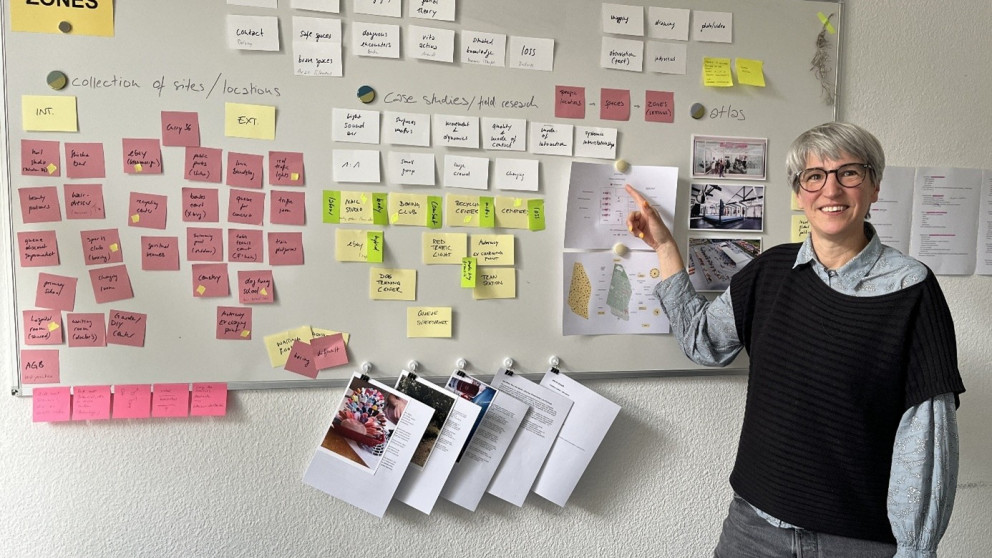
Janke will bring her expertise in shaping physical spaces for transformative settings to the institute’s work. Her current research focuses on identifying everyday spaces where chance encounters and unexpected dialogue take place—from nail studios to boxing rings to charging stations for electric vehicles. She is inspired by theoretical approaches such as Donna Haraway's "situated knowledge," Hannah Arendt’s “vita activa” and Heinz Bude’s concept of the “dangerous encounter” which call for an active engagement with different perspectives and lifestyles.
“I have developed a deep understanding of spaces over many years, enabling me to apply this expertise to new contexts,” explains Janke. “I look at what everyday spaces exist where these chance contacts – or dangerous encounters – take place, or where people with different opinions meet.”
The aim of her project is to re-imagine spaces like EV charging stations, nail studios or hospitals. Janke plans to share her findings (provisionally titled “Brave Zones”) at scientific conferences (COPs), in educational settings, and in democratic processes (citizens’ forums), and to develop recommendations for spatial design.