Pursuing Ambitious Sustainability Policy in Tough Times
08.12.2025
With more than 300 participants, 52 sessions, transdisciplinary exchange and artistic interventions, the RIFS conference Tough Conversations in Tough Times (December 3-5) brought together experts from academia, civil society, policymaking and the field. Over three days, participants explored the growing opposition to ambitious sustainability policies and possible responses to the changing landscape of public debate. The focus of discussions ranged from democratic innovations and sustainable consumption to the impact of artificial intelligence on the transformation towards sustainability.
As RIFS Director Doris Fuchs explained, addressing issues such as consumption limits and power asymmetries has always been difficult. Today however, geopolitical tensions and armed conflicts have pushed sustainability concerns into the background: "We are no longer talking so much about the how of transformation, but increasingly about the if,” she noted. The conference sought to gain a better understanding of this shift and identify constructive pathways forward.
RIFS Director Mark Lawrence highlighted three guiding questions for the discussions: “What are the causes of the current backlash against sustainability-oriented transformations? What kinds of strategies do we need to counteract this kind of backlash? And then finally, what kinds of knowledge and research do we need to promote just sustainability-oriented transformations in the face of these challenging times?”
Media
RIFS Conference Video
According to Fuchs, the strong response to the call for proposals demonstrated how widely these questions resonate across the research community.
Finding common ground in health
In a video message, physician and TV host Eckart von Hirschhausen underscored the value of health-centred communication for climate action. He argued that shared concerns about physical and mental well-being can bridge political divides and urged science communicators to highlight the health benefits of climate protection measures more prominently.
Media
Eckart von Hirschhausen at the RIFS Conference

Creating a sense of unity in a wounded world
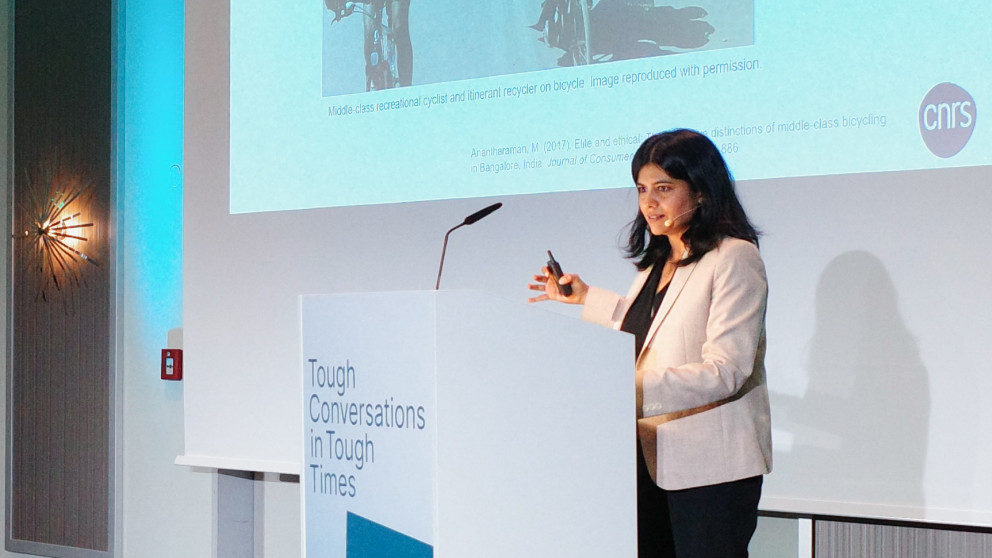
In her keynote "Building 'We' in a Wounded World", Manisha Anantharaman (Sciences Po Paris) explored the challenge of forging cross-class alliances to address sustainability challenges. Anantharaman emphasized that inequalities rooted in capitalist economies—shaped by colonial histories and gendered and racialized power relations—play a critical role here and noted that: "How welfare states were historically built on imperial resources is rarely visible in everyday life. Instead, people make sense of these vast differences on the basis of individualized narratives of merit." The misconceptions that result from this frequently hinder the formation of broad coalitions.
Anantharaman highlighted how marginalised groups can reshape sustainability debates when their perspectives are meaningfully included. As an example, she pointed to the recent negotiations on a global plastics agreement in August 2025, which failed to reach a consensus: “The fact that we avoided a weak compromise – one that would perpetuate plastics overproduction and entrench the political power of petrochemical and fossil fuel industries – is thanks to the coalitions that have been formed between waste workers, between indigenous people, between scientists and other standpoints that are historically minoritized or marginalized in environmental politics.”
From consensus to polarisation
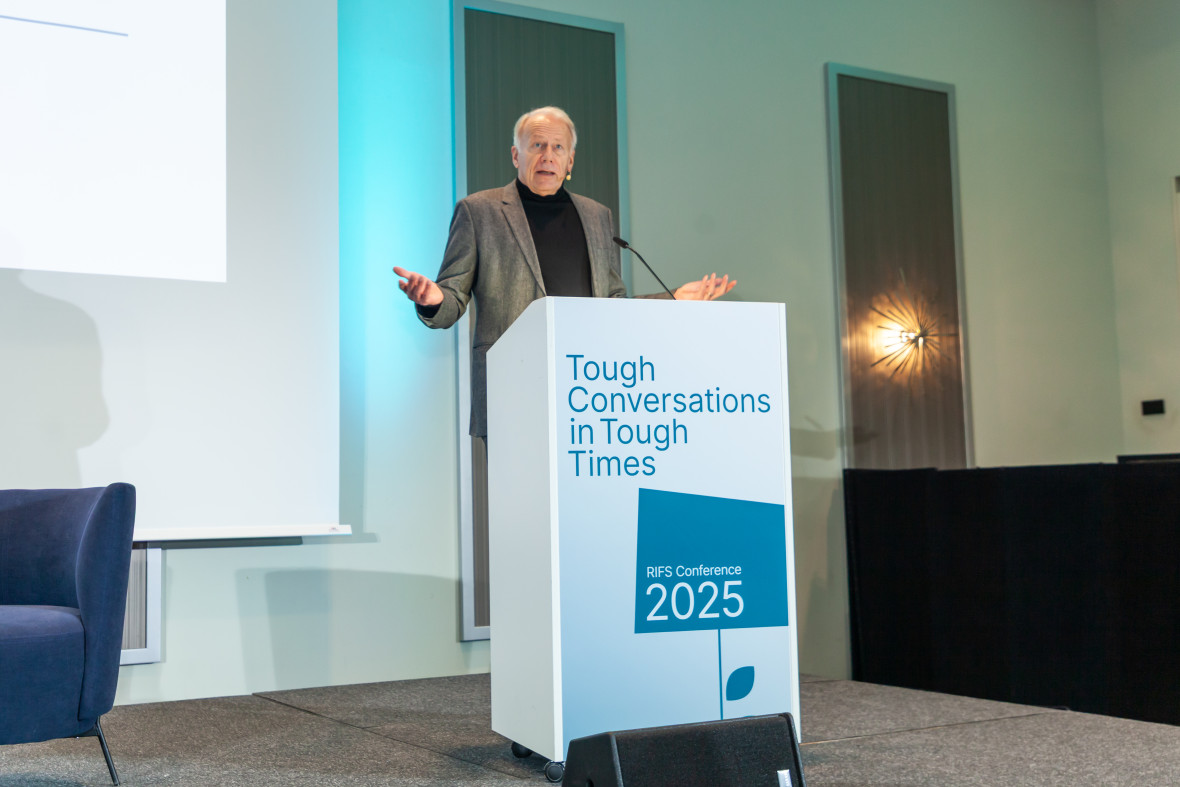
Former Federal Minister for the Environment and veteran German Green politician Jürgen Trittin opened his keynote by asking: "Is reason at an end? How did we go from a consensus on climate protection to the current state of polarisation?" He argued that lobbying efforts and distortions in media reporting have eroded the earlier broad societal agreement on climate action, enabling powerful interests linked to the fossil fuel sector to shape public debate through narratives that are driven by fear.
Trittin stressed the pivotal role of emotions in political discourse. "If you foreground fears of a dystopian future, people become resigned," he said, noting that fear can paralyse rather than motivate action. He emphasised the need to draw on other emotions, such as hope and even love, arguing that only through constructive, emotionally intelligent communication can a positive societal transformation be achieved.
Trittin also said that public broadcasters were "the only guarantee for independent information" and warned that the increasing concentration of communication channels in the hands of a few was jeopardising democratic debate and opinion formation. He warned against being naive when it comes to the internet and the democratisation of communication: “We must not allow a minority of polarisers to dominate public discourse. It is important to combat the spread of misinformation."
Special issue of the journal "Sustainability Science, Practice and Policy"
The keynote speeches sparked in-depth discussion across the conference’s 52 sessions, where questions were explored and new insights emerged. At the final plenary meeting, participants were deeply moved by the many important, insightful, and emotional conversations and encounters.
Summing up the event, Doris Fuchs remarked: “These three days have brought forward many stimulating ideas and many important questions. We will continue to explore these questions in various formats over the coming month.” A special issue of the journal Sustainability Science, Practice and Policy is planned and RIFS researchers intend to collaborate with colleagues on a strategy paper. To broaden the impact of the conference and engage the wider community in these important conversations, a dedicated stakeholder forum will be launched next year. The RIFS blog will also feature a series of reflections on the conference themes in the coming weeks.
Mark Lawrence thanked all of the participants, highlighting the conference’s vibrant mix of formats, including role plays, artistic interventions, and many interactive workshops. “Through all these formats, we could dig deep into the academic exchange. We have opened a door, now we must step through it and continue to engage in tough conversations in tough times."
Photo gallery


Contact