Land in the Context of War: Analysis of Ukrainian Media Coverage
21.10.2026
Nataliia Miroshnyk, a visiting fellow at the Research Institute for Sustainability at GFZ (RIFS), has contributed to a new study examining how Ukrainian media portray damage to land and the destruction of ecosystems. The study shows that ‘land’ has played a central role in reporting on Russia’s full-scale invasion since 2022. While academic debates often emphasize strategic aspects, media present land as a habitat, a danger zone, and part of national identity. The findings suggest that land resources deserve greater attention in international policy pertaining to armed conflicts.
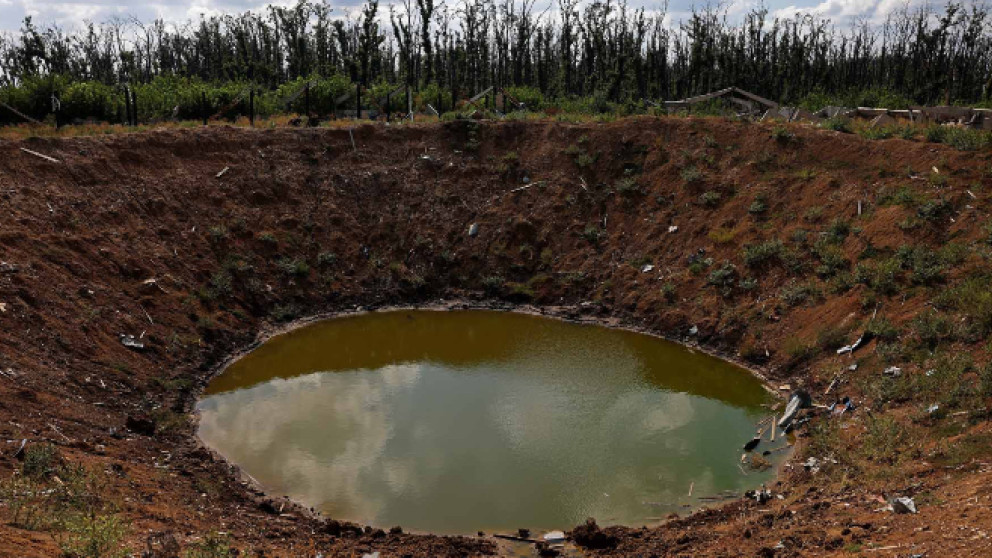
An international team led by Alexander Vorbrugg analysed (online) media reporting on war-related land changes in Ukraine. The study asked: How is damage to land represented? What knowledge do these representations draw on? How does the war affect the symbolic meaning of land and visions of the future? How are material damage and destruction translated into the media discourse? What ideas of landscape does this create?
One of the researchers’ conclusions is that the media play a key role in reporting on the military damage inflicted on the land and ecosystems — particularly for subsequent economic and scientific assessment. Reporting makes visible risks that can often only be identified through technical and scientific expertise.
In addition, the study shows that Ukrainian media present land in a dual role: on the one hand, as an essential foundation for human and non-human life, and on the other h as a space where dangers lurk – from mines or chemical pollution, for example.
Methodology: environmental discourse Analysis
The results are based on a discourse analysis of Ukrainian media coverage since the start of Russia’s full-scale invasion in 2022. The focus was on how the destruction and potential restoration of land are addressed. The team examined the linguistic patterns and layers of meaning used to describe the physical environment in the context of armed conflict. This made it possible to distinguish between the purely strategic view of territory and an ecological and social understanding of land.
Identity, temporality, and the non-human victim
A key finding of the study is the link between land, collective identity, and national history. "Our study shows that in public perception ‘land’ is more than a strategic area or geographical space," says Nataliia Miroshnyk. "‘Land’ is understood as a living medium that both bears the wounds of war and forms the foundation for future reconstruction and national identity." In media coverage, land appears not only as a physical surface but as a medium that transfers war-related damage into the future. At the same time, the potential for ecological recovery is also addressed in these discourses.
Also striking is the portrayal of land as a non-human victim of war in its own right. While academic debate often focuses on strategic territory, media coverage highlights the many meanings that land holds for society and the environment. The study’s findings suggest that land in this broader sense should in future be given greater priority international policy and the analysis of armed conflict.
Publication:
Vorbrugg, A., Volosko, M., Grabovska, T., Miroshnyk, N., & Polianska, K.: Disrupted Lands and Discursive Shifts: Land in Ukrainian Media After Russia's Full-Scale Invasion. Global Studies Quarterly, 2026. https://doi.org/10.1093/isagsq/ksag109

