Finding the Right Mix for Climate Action: Public Preferences for Policy Packages and Their Financing
08.10.2026
The substantial public and private investment required to implement climate policy measures repeatedly brings the issue of burden-sharing to the fore: how can climate action be financed, and who should bear the costs of the transition? After all, public acceptance of climate policy measures is closely linked to how these burdens are distributed and the principles governing their financing. An analysis by the Kopernikus Project Ariadne examines which climate policy packages citizens prefer and how they justify their choices.
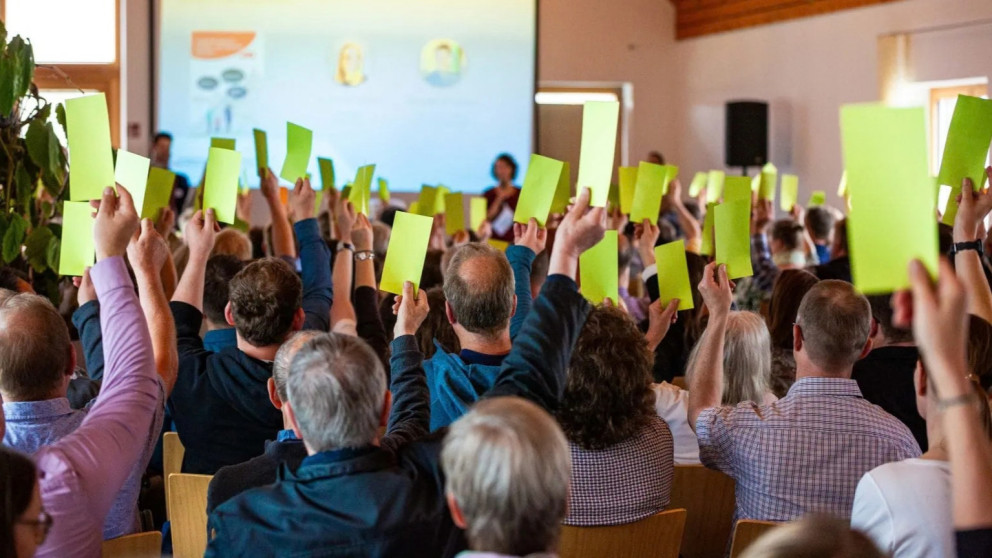
For their study, the researchers combined two approaches: in the Ariadne citizens’ deliberation, participants first took part in an interactiveinformation phase and then discussed various climate policy options and their financing. A representative survey experiment examined how preferences are influenced by different information about costs and policy options. The experiment focussed on policy mixes combining three types of instrument: CO₂ pricing, various subsidy programmes, and regulation, along with their financing – for example, through government borrowing or tax increases.
The results show that many people would prefer a balanced policy mix rather than climate policy instruments implemented in isolation. The preferred option combines CO₂ pricing with subsidies, the latter financed through moderate tax increases. “Acceptance of climate policy doesn’t depend only on how effective a measure is or what it costs. What also matters is how the costs are shared and whether the financing is seen as fair. That’s why income-graduated subsidies and a climate dividend enjoy such strong support,” says lead author Benita Ebersbach (RIFS).
Subsidy programmes are seen as an important lever in climate policy and are perceived as fair, as they help private households with the transition. This remains the case even when respondents are explicitly informed of the comparatively high CO₂ abatement costs of these programmes. Cost considerations, therefore, do not always determine public support for climate policy instruments.
At the same time, the study makes it clear that how people view subsidy programmes depends on how they are financed. For instance, a climate solidarity surcharge (Klimasoli) or reinstating Germany’s wealth tax to finance these programmes meets with relatively broad support. In contrast, a majority rejects an increase in VAT as a financing mechanism, on the grounds that it would not steer behaviour and would place a disproportionate burden on low-income households. The reasoning behind this is that sections of the population with high incomes and wealth should bear a larger share of the costs of the transition.
The Ariadne project’s analysis highlights the added value of combining survey experiments with deliberative participation formats: “Surveys show which policy options have support – and, in the case of an experiment, under what conditions. Deliberation, on the other hand, helps us understand why people prefer certain measures, what notions of fairness underlie their choices, and what compromises they are prepared to make. This provides a very sound basis for designing policy mixes,” explains Ebersbach. The researchers emphasise that developing climate policy able to command broad public support requires not only robust instruments, but also spaces for reflection where citizens can receive information and discuss complex policy questions together.
Publication:
Benita Ebersbach, Katja Treichel-Grass, Karolina Rütten, Tobias Haas, Maximilian Kellner (2026): Klimaschutz im richtigen Mix? Gesellschaftliche Präferenzen für Politikmixe und deren Finanzierung. Ergebnisse aus Deliberation und Survey-Experiment. Kopernikus Project Ariadne, Potsdam. https://doi.org/10.48485/pik.2026.35
Contact