Klaus Töpfer Sustainability Fellowship: Lieselotte Viaene to Develop Guidelines for Ethical Transdisciplinary Cooperation
20.07.2026
How can transdisciplinary collaboration between academic and artistic practitioners be improved? While participatory and co-creative approaches are increasingly popular, Belgian legal and environmental anthropologist Lieselotte Viaene argues that they often lack sufficient grounding in responsibility, accountability, and care – particularly when collaborating with historically marginalised communities. As the Klaus Töpfer Sustainability Fellow for 2026/27, she will be co-creating practical guidance to establish a new foundation for scientific and artistic collaboration.
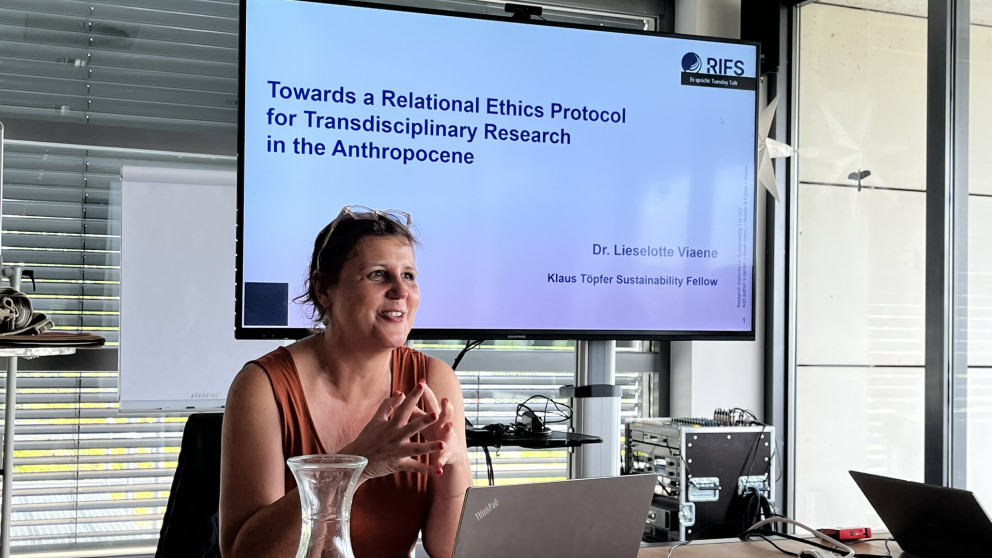
Lieselotte Viaene’s research residency in Potsdam will mark another chapter in a career driven by inter-and transdisciplinary curiosity and a commitment to social responsibility. “I come from a working-class background and have always been interested in the societal impact that research can achieve. Purely theoretical academic debates have never held much appeal for me. If research is publicly funded, it should, in my view, have an impact beyond the academic sphere.”
The idea for her RIFS project grew out of the EU-funded research initiative RIVERS – Water/Human Rights Beyond the Human? (2019–2026), which developed research on environmental harm and Indigenous knowledge in Nepal, Colombia, Guatemala and UN-related spaces. Based at the University of Ghent, Viaene coordinated an international team of Indigenous and non-Indigenous researchers and artists.
From sacred rivers to courtrooms
“Indigenous communities often view rivers and land as living, sacred beings. When an oil pipeline pollutes a river, they don’t see it as damage to the ecosystem alone, but also as harm to spiritual beings and guardians,” explains Viaene. Traditionally, the knowledge of such ‘more-than-human’ entities is interpreted by shamans, healers and elders through rituals and spiritual practices. Indigenous lawyers and judges face the challenge of translating their claims into the categories and language of dominant Euro-western law.
“There have already been some successes in court, particularly with the enforcement of ‘Rights of Nature’ – a concept that doesn’t fully capture Indigenous understandings, but is the closest fit within Western legal systems.” In scientific publications, a podcast series and two documentaries, Viaene and her colleagues described the conflict between Indigenous knowledge systems and the ‘Western’ legal systems.
Meetings online and in Nepal
The project highlighted both the potential and the challenges of collaboration between researchers, artists, and members of local communities. “Questions of authorship, ethics, representation, and different forms of knowledge production emerged again and again, and solutions often had to be developed as work progressed,” Viaene explains. The practical guidance that the Klaus Töpfer Sustainability Fellow will develop at RIFS, together with a team of activist-researchers and visual artists from different geographical locations such as Nepal, Sri Lanka, India, Brazil, UK, Portugal, Belgium, Germany is intended to support future transdisciplinary collaborations.
Among the questions it seeks to address are: How can transdisciplinary collaborations navigate institutional constraints such as funding programmes, university regulations, and administrative and legal requirements? How can research engage ethically with non-human entities as subjects rather than objects? And how can power imbalances embedded in academic structures, funding systems, and authorship practices be diminished?
In addition to online meetings, a four day in-person Living Lab is planned in Nepal for the autumn. Participants will include the members of the creative team of the documentary film produced as part of the EU project, as well as RIFS researchers with experience in transdisciplinary and artistic collaboration. The resulting toolkit is scheduled to be presented next year to both the scientific community and audiences in the arts and film sectors.
Contact
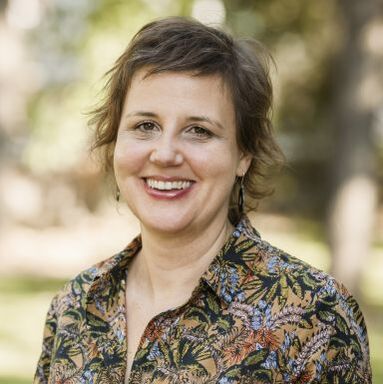
Dr. Lieselotte Viaene