Broad Support for Reducing Through-Traffic in Berlin Neighbourhoods
14.08.2026
A recent study shows that Berlin residents generally support measures to limit through-traffic and redesign public spaces within residential areas. The survey, conducted by the Mannheim Faculty of Medicine at the University of Heidelberg and the Research Institute for Sustainability at GFZ (RIFS), analyses support for so-called Superblock measures (known as Kiezblocks in Germany). The study shows that residents are largely in favour of creating more green spaces and safer streets.
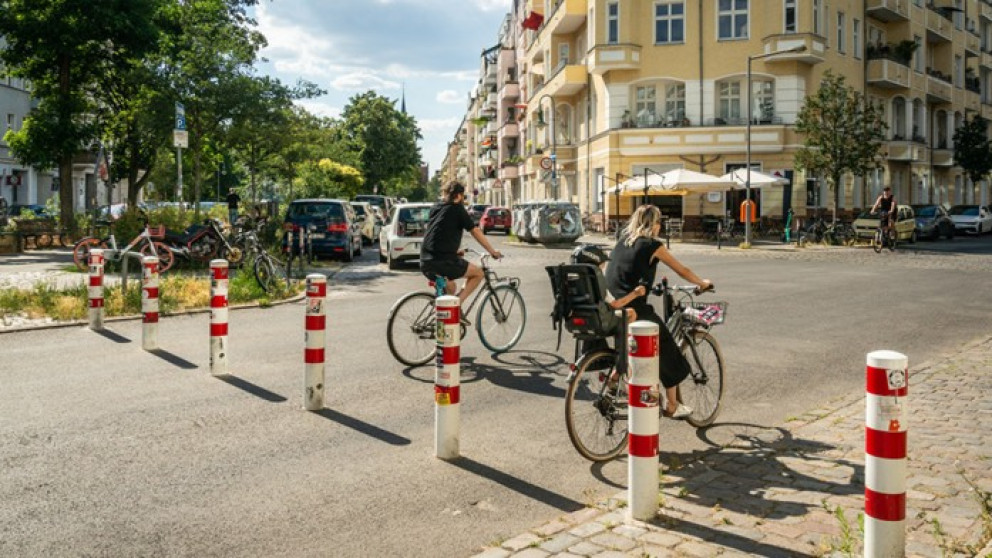
The Klimakieze (climate neighbourhoods) study reveals moderate to high levels of support for traffic-calming measures in residential areas. “To support both the political debate and the evidence-based planning and implementation of Kiezblock measures in municipalities, we examined the public perception of frequently implemented measures among residents of neighbourhoods in Berlin,” says Dirk von Schneidemesser, Research Associate at RIFS. “Our results suggest that support for traffic-calming measures is more deeply rooted than public debate or media coverage often implies; there is a clear interest in redesigning public space to achieve better air quality, increased quality of life, and greater safety in residential areas.”
Broad support for redesigning urban spaces
The survey of 13 specific measures showed support levels ranging between 61% and 88%. Preferred changes include creating space for social interaction, establishing small public squares, and converting parking spaces into green or multi-functional areas.
These measures – known in various European cities as Superblocks in Barcelona, Low-Traffic Neighbourhoods in London, or Kiezblocks in Berlin – aim to reduce through-traffic. Examples include diversions, one-way streets, or school zones, as well as the repurposing of public space previously used for motorised traffic to improve local social and ecological conditions (e.g., through pedestrian zones or green spaces). Such interventions can increase traffic safety, improve air quality, and reduce noise, thereby enhancing the health and well-being of urban populations.
Influence of mobility behaviour and demographics
The study also identified factors influencing the acceptance of these measures. Higher support was observed among individuals who practice active mobility, such as walking or cycling, maintain a strong connection to nature, or live in households with children.
Conversely, intensive car use and higher age correlate negatively with support for the proposed measures. This suggests that attitudes toward urban traffic design are closely linked to personal mobility habits and life circumstances, underscoring the need for targeted communication and participatory approaches.
Even when potential downsides like reduced parking are highlighted, the significant support for Superblock measures suggests that public opinion is far less polarised regarding sustainable mobility than is often assumed. As co-author von Schneidemesser observes: “Measures that enjoy particularly high levels of support, such as creating new green spaces and improving safety – especially for schoolchildren – offer ‘quick wins’ for local authorities. By delivering immediate, tangible benefits, these projects can help secure wider support for the broader mobility transition.”
Methodology
A random sample of 10,657 residents aged 18 and over was drawn from the civil registry and invited to complete the survey online or on paper in German, English, Turkish, Arabic, or Russian. This resulted in responses from 1,480 adults across four Berlin neighbourhoods between September 2024 and May 2025. The study compared two Berlin districts with planned Kiezblock measures – Nördliche Luisenstadt and Antonkiez – with two comparable neighbourhoods without such plans: Stephankiez and Westfälisches Viertel. Support was measured using a six-point Likert scale, ranging from “extremely negative“ to “extremely positive,“ and correlations between acceptance and various socio-demographic and mobility-related characteristics were analysed using linear regression.
Publication:
Lünow, Nicole, Andrea Sarafoglou, Dirk von Schneidemesser, Luis Nacken, Immo Janssen, and Michael Eichinger: “Public Support for Limiting Through-Traffic and Reallocating Public Space in Four Residential Neighborhoods in Berlin and Its Correlates: Results from the KlimaKieze Survey.” Findings, July 24, 2026. DOI:10.32866/001c.164948.
Contact