Better Data for Prishtina's Fight against Air Pollution
16.03.2026
Kosovo's capital Prishtina is among the cities with the worst air quality in Europe. Climate change will exacerbate the problem: Rising temperatures and changes in air currents and precipitation patterns are negatively impacting particulate pollution. Kosovan environmental scientist Adisa Osmani wants to model the future development of air quality in Prishtina during a one-year fellowship at RIFS in order to provide policymakers with a more robust data basis.
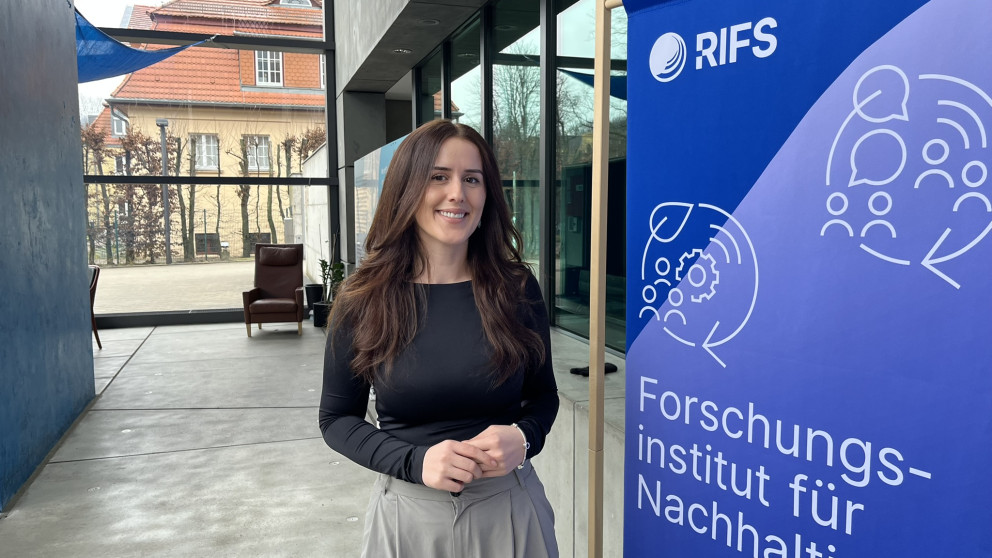
"Traffic in Prishtina is becoming increasingly dense: it's the capital, that's where the jobs are. People commute in by car because public transportation services are poorly developed and unreliable. With this, exhaust pollution is increasing, due in part to an aging vehicle fleet. Added to this are the clouds of exhaust fumes from the nearby lignite-fired power stations. Exceedances of the EU and WHO air quality limit values are common," says Osmani. The World Bank estimates that 760 premature deaths a year in Kosovo are caused by air pollution, a high figure for a country with a population of just 1.7 million.
Implementation is lacking
The Kosovan government wants to adopt the environmental standards of the European Union, including the limit values for particulate matter. Parliament has passed a corresponding law on air pollution control. However, the geographical conditions are difficult, as Prishtina is located in a valley basin where cold layers of air often act like a "lid" and trap pollutants on the ground. This leads to extremely high levels of particulate matter, especially in winter.
"The implementation of concrete measures has so far been slow, mainly for financial reasons. The concentrations of pollutants in Prishtina have been going down somewhat, but are still well above the EU limit values. Politicians must therefore take urgent action to protect people's health," says Osmani.
Germany has shown how climate data can be successfully incorporated into the fight against air pollution, explains Osmani: "With modern measuring systems, clear laws and proven computer models, Germany has significantly improved its air quality. Transferring such approaches to Kosovo can help to combat air pollution there more effectively - through knowledge transfer, research and concrete political measures." With her work at RIFS, Osmani wants to contribute to a better data basis for political measures.
Working at the interface between science and politics
At the start of her project, the environmental management expert will analyse air pollution and weather data from 2010 to 2023 and then use climate models to forecast future air quality under different scenarios - both moderate and high pollution - with a view to the 2030s and 2050s. She will compare the results with historical data and produce maps to show where pollution could worsen.
The RIFS research group "Modelling Air Quality for Policy Advice" offers an inspiring environment for her project, says Osmani: "Being surrounded by people who not only know a lot about modelling, but also work at the interface of science and policy is ideal for the success of my project."
Fellowship from the German Federal Environmental Foundation
Like many of her RIFS colleagues, the 26-year-old has already gained experience in research, politics and practice: During her studies at the International Business College Mitrovica, she worked on a field research project for the Food and Agriculture Organisation of the United Nations (FAO) on the consequences of flooding in Kosovo. She also coordinated various activities on adapting agriculture to climate change for the non-governmental organisation Initiative for Agricultural Development of Kosovo.
Osmani's stay at RIFS is funded by the German Federal Environmental Foundation as part of the Fellowships for University Graduates from Central and Eastern Europe.
Contact