Addressing Loss and Damage Needs a Transdisciplinary Approach
15.06.2026

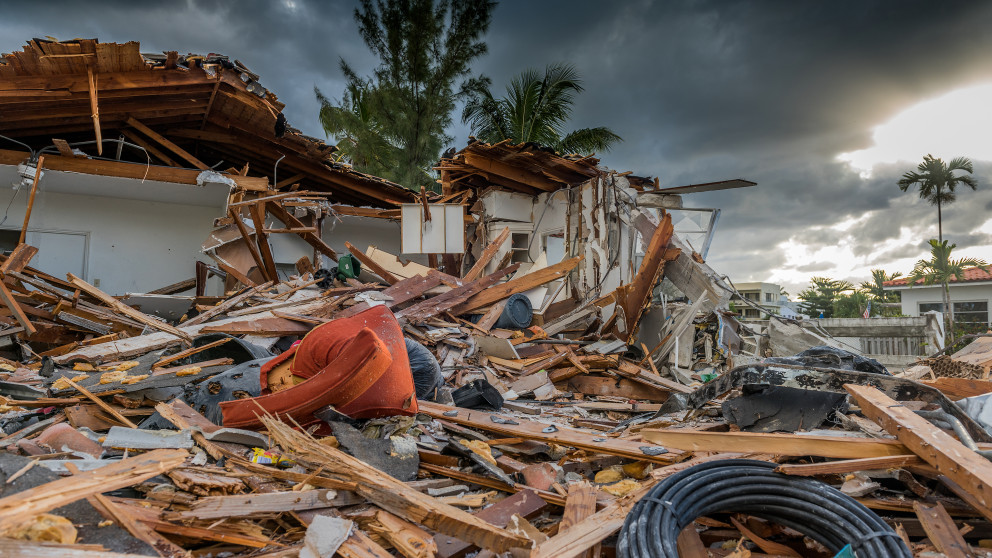
Loss and Damage (L&D) from climate change is a complex, multi-perspective issue spanning norms, values, material and financial assets, individual lives, cultures, political and business interests as well as governance processes with a multitude of actors and sectors involved. Amid this complexity, effective solutions to L&D challenges can only be developed through interdisciplinary and transdisciplinary approaches.
What is ‘Loss and Damage’?
When measures to mitigate climate change and adapt to its consequences fail to avert and minimise the effects, extreme weather events and slow environmental changes bring destruction. They take lives and livelihoods and devastate places of worship and comfort, historical treasures, vital infrastructure, and environmental processes we depend on for food, water, and clean air. In some cases, entire cities and even countries are at risk.
The issue of L&D was first addressed in UN climate change negotiations in the 1990s, but it took twenty years for the first international governance mechanism to be established and another decade to establish a global fund. The Fund for Responding to Loss and Damage (FRLD) is geared towards supporting the most vulnerable to the impacts of climate change, namely those nations with the least resources to address them.
Current challenges to addressing L&D
One of the biggest challenges is the availability of funding. Current pledges to the global fund are important signals but amount to little more than a drop in the ocean. Germany’s – politically highly important – pledge of USD 100 million (approximately €92 million) helped kickstart the fund’s operationalisation. But just compare this to the estimated €4.1 billion in damages that occurred during a single flood event in South Germany in summer 2024. In contrast, Germany’s pledge seems almost insignificant on a global multi-year scale. Much more is needed, but progress on this issue is being hampered by economic stagnation, rising right-wing populism, increased spending on military security and a significant shift in US priorities.
An important related challenge is the question of how non-economic L&D (NELD) can be measured, assessed, and addressed. It is much more straightforward to calculate the costs of lost material assets such as a house, a train track, or a harvest; much less so, however, to put a price on a life, on memories, ancestral burial grounds, place-based cultural traditions, and the loss of identity. While economic L&D has received more attention, NELD is just as important to consider, not least due to its psychological impacts. But defining and valuing it is immensely challenging because it is not easily generalisable and quantifiable.
A third major challenge is access to, and self-determined use of, the funding. The FRLD wants to do things differently than other climate finance mechanisms. Instead of channelling money through many intermediaries, it wants to provide direct access for community organisations, Indigenous Peoples, and other groups of affected populations in developing countries. However, it remains to be seen whether these access modalities are easy enough to navigate and whether local communities have genuine decision-making power over resource use.
The scholarly exercise so far
Academics have been dedicating more and more research to the topic of L&D. They are investigating how the physical limits to climate change adaptation result in residual risks, how accountability for climate change impacts is linked to moral responsibility and global justice, and how much money will be needed globally to finance responses. Many different disciplines have examined these questions from their own disciplinary perspectives and theoretical and methodological specialisms.
Despite persisting political barriers to L&D, we can argue that the discussions have widened from “making a case” for L&D as the third pillar of climate governance to the actual “how to” of addressing L&D on the ground. The global fund is starting to finance the first round of projects this year and knowledge networks have formed to collect and analyse best practices around the world.
How inter- and transdisciplinary research can find solutions
It has become increasingly clear that research must adopt a more inter- and transdisciplinary approach to facilitate transformative processes in L&D governance. In multi-disciplinary research, each discipline works in parallel, focusing on its own contribution to tackling a problem. This siloed approach often results in solutions that are developed without considering their broader implications for other areas. For example, when studying climate risks, some researchers focus on “natural hazard risks”, some on “social risks”, and others on “business risks”, failing to account for their interlinkages. This is detrimental to effectively addressing a multi-dimensional issue like L&D. By contrast, researchers working inter- and transdisciplinarily actively seek common ground and points of connection. These approaches understand climate risks as dispersing into natural, human, and economic systems, and researchers consider the implications of solutions for other risk categories as well.
Securing adequate funding for L&D depends on keeping the issue high on the agenda of UN climate negotiations and holding industrialised countries and major emitters accountable. To achieve this, it is imperative to advance an integrated risk definition and effectively communicate the systemic dimensions of L&D. Approaches are needed that link the political, economic, and social risks emanating from climate change, including displacement and migration, impacts on value chains, unemployment, food security as well as such effects as conflict, extremism and lost educational opportunities for young people. Demonstrating how L&D issues contribute to broader challenges such as instability, economic stagnation, and political polarisation can help to strengthen the case for investment by governments and enterprises.
When it comes to defining and quantifying NELD, a grounded approach is needed that considers local and individual perspectives and draws on practical experience. Attribution science, for example, increasingly informs legal scholarship and actual climate litigation, drawing on local knowledge of how climate impacts are experienced in affected communities. In a similar vein, legal anthropologists, urban ecologists, digital humanists, and neuro-economists could collaborate with affected communities to develop integrated methodologies to define and quantify NELD, establishing precedents that could influence political debates around this and related issues.
Localised and contextualised solutions are crucial not only for securing access to L&D funding but also for ensuring its effective use on the ground. Just as work on NELD benefits from transdisciplinary approaches, efforts to address questions around access to L&D funding are improved by combining insights from several disciplines and actors. Testimonies from local communities and Indigenous Peoples as well as the collection of best practices by civil society organisations and local government administrations from various countries serves to identify what does and does not work in different contexts. Social and political scientists from various disciplines are well-placed to investigate social protection systems and cash transfers, while development cooperation and humanitarian actors have the networks and tools to provide capacity development, and local voices know best where and how to use the funds.
Enabling transformations
Co-creating ideas, frameworks, and mechanisms fuses scientific knowledge with real-world practice, establishing context-appropriate solutions that are both localised and provide best practice examples for adaptation. Input from different levels of the L&D finance ecosystem is important to inform effective governance mechanisms, from local communities to the global fund. Ultimately, research funding bodies must embrace high-risk, high-reward transdisciplinary research that takes a “learning by doing” approach. This will allow us to advance knowledge and practice simultaneously and overcome the boundaries that continue to inhibit the transformations we so urgently need.