A Polaroid of Polarisation
16.04.2026

What the real mood in Germany is like
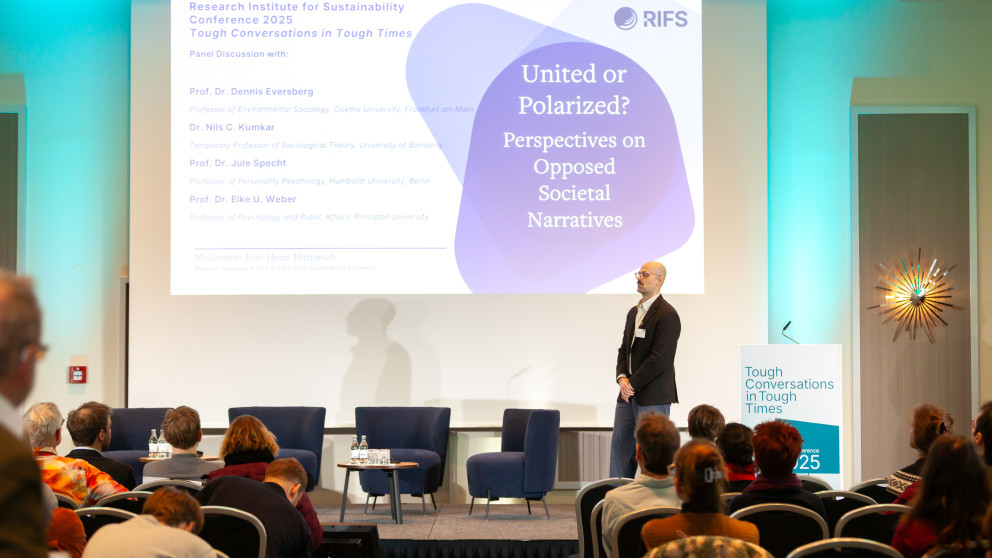
Imagine this: a quiet village in southern Germany, wind turbines, and a referendum that ended with 55 per cent against and 45 per cent in favour. Sounds like fierce polarisation? Not necessarily. As experts gathered for a panel discussion on the question of societal division or unity at the RIFS conference “Tough Conversations in Tough Times” explain, numerous surveys show that large majorities support the fundamental call for greater climate protection as well as many measures.
Some, however, warn that a “defensive consensus” is increasingly taking shape in Germany when it comes to specific policy measures perceived as unfair and expensive – in this respect, the population resembles a sort of group photo in which most people want to look good in principle, but it is impossible to capture everyone looking good at the same time. Wind turbines? Just one example of a country wavering between sustainable change and “business as usual, but please not worse”.
This blog post is part of a series on the 2025 RIFS Conference "Tough Conversations in Tough Times".
The figures that raise more questions than they answer
A study from the summer of 2025 states: over 50 per cent are “progressive” on climate policy, while only 18 per cent are regressive “climate sceptics”. Ten per cent are ambivalent, meaning, for example, that they view the climate crisis as a problem in principle but are concerned about the costs of the solutions. The rest? “Indifferent” – in other words, people who would rather curse the weather and ignore it than discuss it.
Another study from autumn 2025 reveals: on average, people in Germany want their preferred party to show more commitment to climate protection than they currently perceive – while this does not apply to voters of the FDP and AfD, theyat least do not want any less. RIFS is currently conducting a survey that will provide even more up-to-date findings on prevailing public opinions and assessments of the transition – the results will be available in the summer. But beware: social desirability may also play a role here. Just like a mate who ‘naturally’ claims to be vegan in surveys but secretly eats currywurst in the evenings, many people answer questions with what they consider politically correct. The real picture? More complicated than an Instagram filter.
The experts and their polarisation puzzle
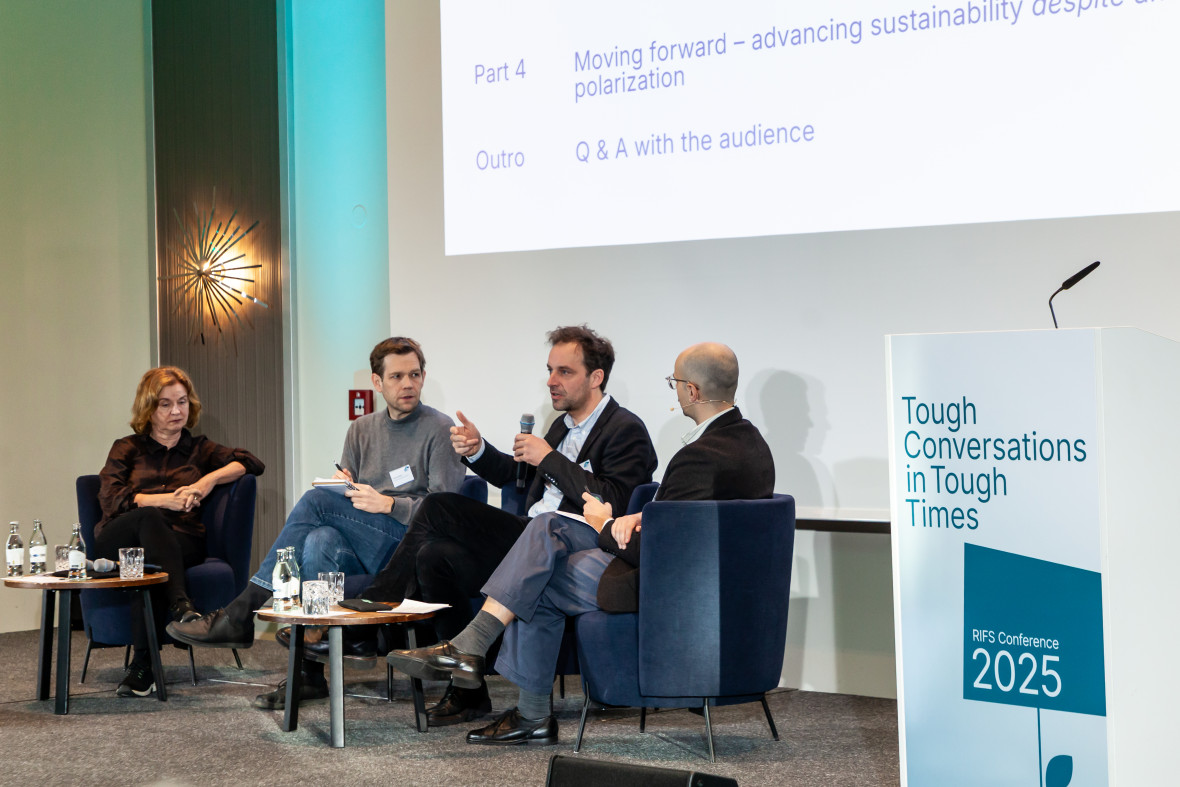
Dennis Eversberg, Professor of Environmental Sociology at Goethe University Frankfurt. Previously, he led a BMBF junior research group in which he and his colleagues investigated prevailing mentalities in Germany, their socio-structural basis, and their role in socio-ecological transformations. Building on this work, he and his colleagues have written a book on the subject: “The New Socio-Ecological Class Conflict”.
Nils Kumkar, research fellow at SOCIUM – Research Centre for Inequality and Social Policy at the University of Bremen. His research interests lie in the sociology of knowledge and communication. Last summer, he published “Polarisation: The Order of Politics” with Suhrkamp, which explains why polarisation is an integral part of politics and public life.
Elke Weber, Professor of Environment and Energy and Professor of Psychology and Public Affairs at Princeton University since 2016. She co-authored the chapter “Social Aspects of Climate Change Mitigation” in the latest IPCC report. Her research interests include how the public develops its attitudes towards climate and sustainability, and the role played by the perceived social context.
Based on his research into socio-ecological transformation, Prof. Eversberg outlined:
"Not polarisation, but a triangular relationship!"
– there is no clear picture of polarisation; rather, it is a constellation of three ‘spectra’ of basic attitudes within the population that is fraught with tension in multiple respects.
There is:
- Eco-social support for climate policy and transformation, from which people say: “Yes, the government should act more decisively and we are also prepared to change our lives.”
- A conservative focus on growth and prosperity with an increasingly defensive tendency: here, concerns about environmental and climate crises are shared and the fundamental need for change is acknowledged, yet at the same time, people wish to preserve their own material prosperity and their accustomed way of life. “I do want us to protect the climate, but surely not everything has to change in the process!?”
- Angry or overwhelmed resistance: from these perspectives, calls for change appear as an additional threat amidst an already prevailing sense of uncertainty, which is met in some cases with withdrawal, but more often with resolute resistance. “The self-proclaimed saviours of the world are the real danger!”
In 2021, roughly a quarter of people in Germany could be classified as belonging to the former and the latter groups, whilst the second – referred to in the book by Eversberg and colleagues as the “conservative-growth-oriented” spectrum – accounts for the largest share of the remainder at around 40 per cent: It is precisely this spectrum that is currently becoming increasingly defensive, as the compatibility of conventional lifestyles with a sustainable future for all is being called into question with ever greater clarity. This idea is taking centre stage – and is diminishing support for comprehensive change among this section of the population.
Prof. Eversberg: “I would say that there is a convergence between the conservative-growth-oriented spectrum and the defensive-reactive spectrum. That is why I would speak of an emerging defensive consensus rather than polarisation.”
Dr. Kumkar: “The only thing many people agree on is that politics isn’t working as it should. Otherwise, there really isn’t much common ground between all the different ideas of what polarisation actually means.”
Kumkar’s concept of ‘communicative polarisation’ explains why everyone talks about division, even though the opinions revealed in surveys are not actually that far apart. One factor is that political actors thrive on the distinctiveness of positions; polarisation is therefore inherent in the systemic logic of modern political communication. Even though Merz and his colleagues are now close to Habeck’s proposals in some policy areas, they are forced to distance themselves from him. Another factor is the media logic of the attention economy, which means that “extreme opinions” go viral more easily. This is also the case with party communication on social media – fringe parties have greater visibility, according to a study by the Bertelsmann Foundation in collaboration with the University of Potsdam. Example: “If your uncle only sends you TikTok jokes from right-wing populists, you think Germany is polarised – even though he’s just bored.”
Prof. Weber: “People are complex. They want many different things, which are often contradictory. This means reality is not as black and white as social media feeds suggest.”
Prof. Weber reports from her research that a false social reality is often perceived. The key academic term here is ‘pluralistic ignorance’. Many people do not seem to realise that there is actual majority support for political measures that are perceived by many as controversial. This finding is evident in Germany just as it is in many other countries around the world, including the USA. This is relevant to the success of transformations because, if the collective does not know what the majority of its members want, this weakens the collective’s ability to act.
Why it is (not) a bad thing when society is divided
- Affective polarisation: this is where things get emotional. Suddenly, the other side is no longer ‘different’, but ‘jerkish’. This type of polarisation describes a situation where people feel a particularly strong connection to like-minded individuals whilst simultaneously treating those with differing views with rejection or negative feelings. The “us versus them” mentality hinders dialogue and cooperation, because when people see red with anger towards others, potential solutions and compromises vanish as if behind a red rag. An interdisciplinary research team is dedicated to this topic for Germany and Berlin.
- The role of public communication: whether it be the media or politicians, statements tend to favour drama. “Climate vs. schnitzel” sells better than “We’re all trying to get by”. However, this does not help a factual, solution-oriented debate. As reality usually isn’t as bad as the headlines suggest, more moderate communication would promote social understanding.
- The material basis: When we talk about people’s opinions, their unequal access to material resources tends to be overlooked. An ever-smaller number of people are exerting ever-greater influence – on the one hand through their wealth and excessive lifestyles, and on the other hand through the (political) structures that could slow down the emergence of these unjust inequalities.
Solutions? More pool, fewer pool parties
- Infrastructure instead of ideology, or public swimming pools instead of private pools for everyone. This striking example may sound banal, but it conserves resources. And just as important: community projects and credible access to shared, essential infrastructure create shared experiences and reduce the fear of change. In the spirit of the demand “polarise – but properly”, which builds on the established inevitability of polarisation in the political sphere, society could perhaps also be mobilised against the ever-increasing privatisation that disregards the many benefits of public goods.
- Talk, but where? We need forums for citizens that do not smell like seminar rooms. Spaces where genuine listening is possible. Citizens’ assemblies in Germany have already shown what happens when people stop talking past one another: People thrown together by chance, who would never actually have met, surprisingly often find common solutions – not because they suddenly agree, but because they have understood the needs behind the other’s positions. The goal is not unanimity, but shared understanding – that is the prerequisite for achieving something together, and an insight that also emerges from the work of the recently deceased Jürgen Habermas.
- Humour as a tool: Try throwing in a joke when the lines have become entrenched. Humour is perhaps the oldest antidote: it creates a space where sensitive issues can be addressed without the trenches being dug immediately. Not because it downplays problems, but because it briefly eases the tension – and in that brief moment of relaxation, more genuine understanding sometimes occurs than in hours of serious debate. People can laugh at something and still take it seriously. That’s not a weakness; it’s social savvy. “Example: ‘Should we build wind turbines?’ – ‘Sure, but only if they repair the main road.’ – As national laws on local participation in the expansion of renewables spread, they might actually do just that soon.”
Conclusion: Polaroid instead of polarisation
To bring the Polaroid image of Germany into focus and see the country as it really is, you need to adjust the zoom perfectly – and at the same time look beyond the image. The media, social networks and political rhetoric set the lens to maximum magnification, and suddenly every crack seems like an abyss. What many perceive as deep division is a perceptual effect brought about by this very phenomenon. Yet most people are closer to one another than the daily disputes would suggest. However, if the zoom is set too low, one misses emerging conflicts, including those concerning recognition and the meaning of a good life. Ultimately, one needs to look beyond the image. For what people consider desirable, achievable and self-evident – and thus what they wish to change or preserve – is largely determined by the circumstances in which they live. And existing unjust conditions run the risk of being exacerbated by change that is not sufficiently socially sustainable. In this respect, Germany is not polarised but is increasingly ‘polar-oid’ – that is, polarisation-like.
The solution? Less debate about whether the majority of people in Germany are ‘polarised’. More focus on what we can improve together. And above all: clearly identifying which poles in the social sphere are actually those that bear the greater responsibility and also have the means to champion change. For the conflict between people who actually have much in common does not arise by chance — it is, as it were, the consequence of hardening material structures as well as the business model of those who wish to prevent people from joining forces and collectively demanding change where there is truly something to be gained.
Contact