"Seeing each other's pain" – in search of a new "we" in sustainability policy
11.12.2025
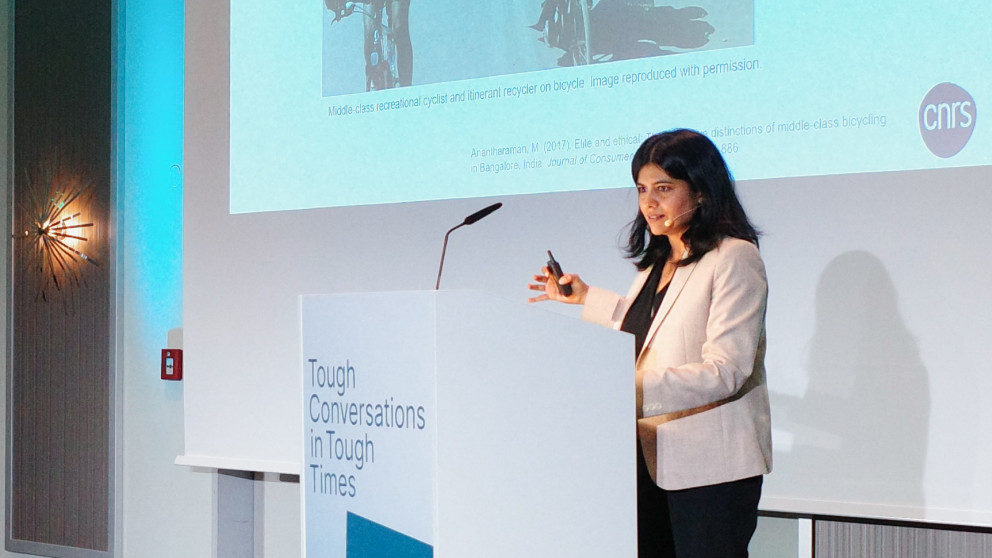
We all have an interest in protecting our planet. But our unequal living conditions make it difficult to forge cross-class alliances for an ambitious sustainability policy. In her keynote speech "Building 'We' in a Wounded World" at the RIFS Conference 2025, Manisha Anantharaman (Sciences Po Paris) made an appeal to researchers and leaders: they should learn from the people who are fighting environmental problems on the front line to explore the types of political coalitions that challenge entrenched power structures.
This blog post is part of a series on the RIFS Conference 2025, "Tough Conversations in Tough Times".
We live, said Anantharaman, in a world characterised by colonial experiences, racism and gender inequality. In everyday life, however, it is rarely apparent how much the wealth that was accumulated through dispossession continues to structure opportunities. "Instead, people make sense of these vast differences on the basis of individualized narratives of merit." This is a misinterpretation, she said, because rather than individual achievements, it is the social group we belong to that determines our place in the world and the way we approach sustainability issues.
Elites dominate the discourse
The fact that each group perceives environmental problems in a different way leads to fragmented politics that is dominated by the views of the elites. "Marginalised or minoritised subjectivities are pushed aside and it becomes very hard for people to come together across diverse social and political boundaries."
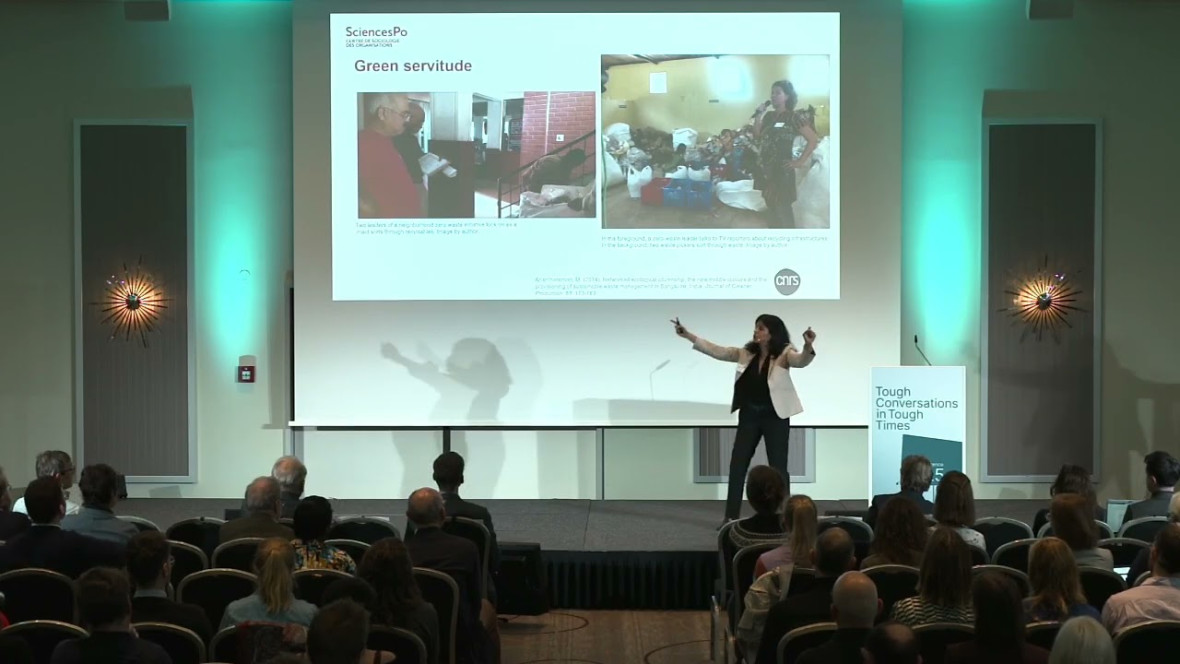
As an example, Anantharaman cited the discussion about waste disposal in India, where members of the Dalit caste, the lowest social class, do most of the cleaning work. In her field research, however, she found that the Dalit were often blamed for the presence of waste, simply because they live near the landfills. "They were responsiblised for it, both being blamed and asked to do the work to clean it up at the same time, all while again being kept at the margins of environmental politics." This shows that members of higher castes use "environmental awareness" as a pretext for making strong moral judgements.
Media
Building "We" in a Wounded World: Cross-Class Alliances and the Challenge of Environmental Justice. Keynote by Manisha Anantharaman
Lack of appreciation shapes identity
However, poor working conditions are not limited to India or the Global South. They are widespread worldwide. "They've come to Europe with Uber, with flexibilisation, with gig work. The devaluation of work has democratised." The people who do this dirty or dangerous work are seen as inherently suited to it, often because of their gender, ethnicity, caste or migrant status.
This devaluation shapes their identities and is ultimately also politically problematic. It prevents people from building the kind of solidarity needed to counter the interests of the elite. Unfortunately, Anantharaman said, consumption, which places a heavy burden on planetary resources, is a means of gaining prestige and social affiliation.
Marginalised groups at the centre
Instead of recognising inequality and the diversity of experiences and perspectives, the "professional managerial class of sustainability" is constructing a "we" that does not exist, said Anantharaman. Their task now is to focus less on their own perspective and learn from the people who have long borne the brunt of capitalist economies and environmental degradation. "Ultimately, rebuilding a ‘we’ in this wounded world requires acknowledging history, seeing each other's pain, recognizing each other's pain as legitimate."
If marginalised groups succeed in bringing their points of view into the sustainability discourse, environmental problems will be redefined and the misjudgements of the elites will be called into question. As an example, Anantharaman pointed to the recent negotiations on a global plastics agreement in August 2025, which failed to reach a consensus. "The fact that we avoided a weak compromise – one that would perpetuate plastics overproduction and entrench the political power of petrochemical and fossil fuel industries – is thanks to the coalitions that have been formed between waste workers, between indigenous people, between scientists and other standpoints that are historically minoritized or marginalized in environmental politics."
Taking this as inspiration, said Anantharaman, we should continue our search for a safer, healthier way of living, and form coalitions to counter the power of those who benefit from the current status quo.