Hybrid Energy Revolution: Superconducting Cables and Liquid Hydrogen
09.03.2026
A new study demonstrates the feasibility of transmitting both electricity and liquid hydrogen through a single pipeline. Scientists Adela Marian (RIFS) and Christian-Eric Bruzek (ASG Superconductors), working within the European research project Scarlet, argue that a ‘hybrid’ or ‘dual’ transmission system offers a more efficient and affordable way to deliver energy.
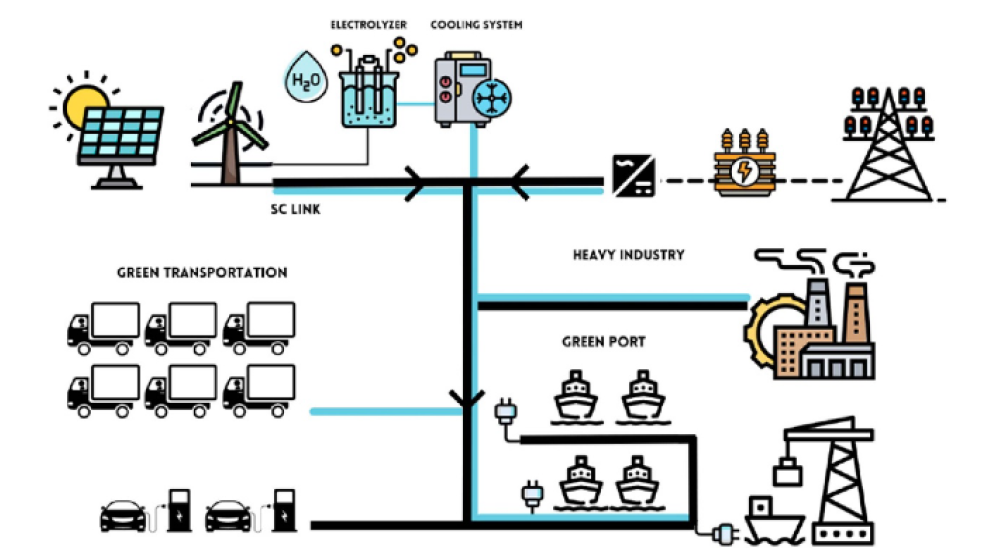
Meeting the demands of the energy transition, including electrifying heating and transportation and integrating more renewable energy, will necessitate massive investment in electricity grids. Superconductors offer a critical advantage: high current densities with zero resistance. The recently published roadmap article “Superconducting high-power cables and lines—Development status and technology roadmap” includes 19 contributions from various authors and summarises the most important and latest research and development activities in the field of superconducting cables. RIFS researcher Adela Marian and her colleague Bruzek outline their work on the development of a hybrid energy distribution system in Chapter 19.
With hydrogen poised to play a key role in efforts to achieve decarbonisation goals worldwide, its efficient distribution is becoming increasingly important. Marian and Bruzek’s method could significantly reduce costs by sharing infrastructure for electricity and hydrogen transmission. The team also notes that revenue generated from hydrogen delivery can offset the costs of the cooling system.
This technology holds significant promise for energy-intensive industries such as the metallurgical and chemical industries, but also for low-carbon transport systems, for example in green ports, where large quantities of electricity and hydrogen are required (see illustration).
Technical challenges and potential solutions
Scarlet addresses several technical challenges, including maintaining electrical insulation at extremely low (cryogenic) temperatures ranging from -200 to -250 degrees Celsius and the development of a cooling system for liquid hydrogen as well as secure cable accessories. The cooling system leverages proven industrial solutions for cryogenic liquids, but requires specific adaptations for hydrogen.
A hydrogen-cooled cable system including two terminations is currently being produced and prepared for testing. This will be the first full-scale prototype for the combined transport of electricity and hydrogen that meets the requirements for grid integration. Characterizing and validating liquid hydrogen as an insulating medium, along with long-term testing, will be key to defining safety standards for hydrogen operations and recommendations for a superconducting medium-voltage DC test standard.
The completion of the Scarlet project contributes to the integration of superconducting technologies into energy infrastructure. The technologies developed in this project will enable the widespread deployment of hybrid energy distribution systems and support decarbonisation across various industrial sectors. Combining electricity and hydrogen transport promises to provide an efficient and sustainable energy supply for the future.
Publication
Christian-Eric Bruzek and Adela Marian: MgB2 power link with liquid hydrogen, Chapter 19 in: M Noe et al: Superconducting high-power cables and lines - development status and technology roadmap, Supercond. Sci. Technol. 39 (2026) 023501, DOI: 10.1088/1361-6668/ae15c2.