Community Energy in Germany’s Coal Regions: Enabling Genuine Participation
26.11.2026
In Germany’s lignite-mining regions, the involvement of local people will decide whether the energy transition succeeds. What encourages citizens to get involved in supplying their own energy? Sophie Dolinga of the Research Institute for Sustainability at the GFZ (RIFS) has investigated this question in a new RIFS Study covering two case studies: Lusatia and the Rhineland mining area.

The lignite phase-out is transforming the affected regions both economically and socially. Citizens are usually involved in these changes through information and dialogue events, but opportunities to shape them directly and to share in the benefits often fall short of expectations. This is where community energy comes in. Dolinga defines community energy as collective initiatives in which people join forces to carry out energy projects themselves. A key feature is that both decision-making power and financial returns stay with participants in the region.
In Germany, such projects are organized in various ways, often as cooperatives. They keep more of the economic value in the region and can increase public acceptance of wind turbines and solar installations, because residents are no longer simply affected by them but help shape them and share in the profits. There are an estimated 3,000 energy communities in Germany today.
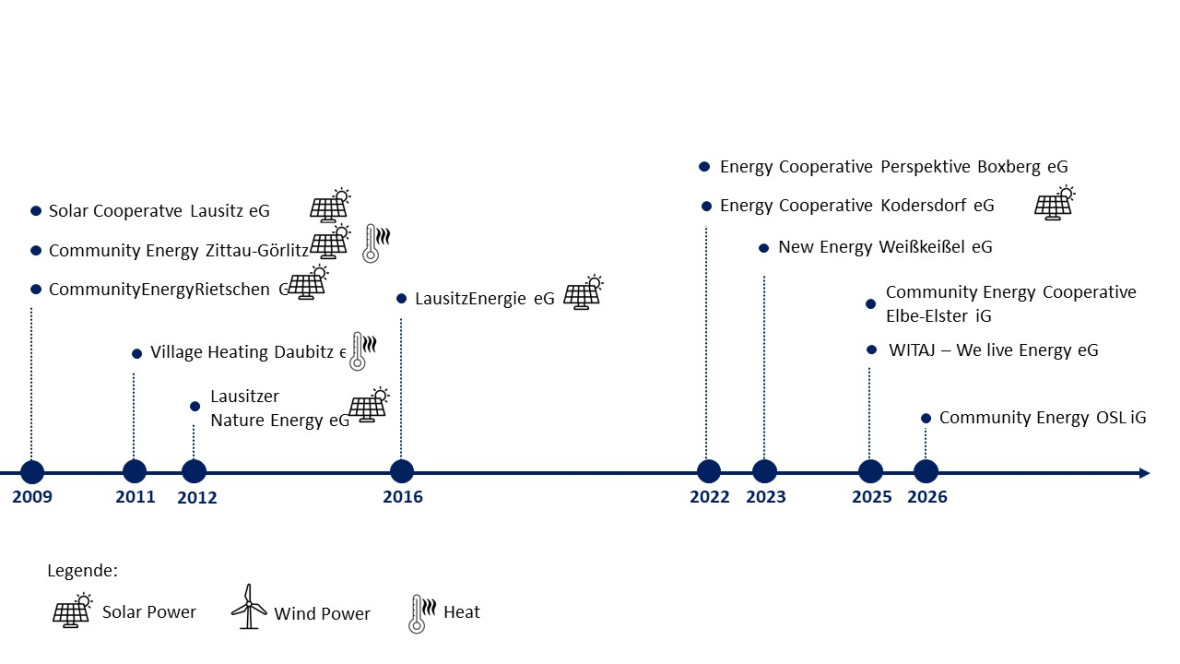
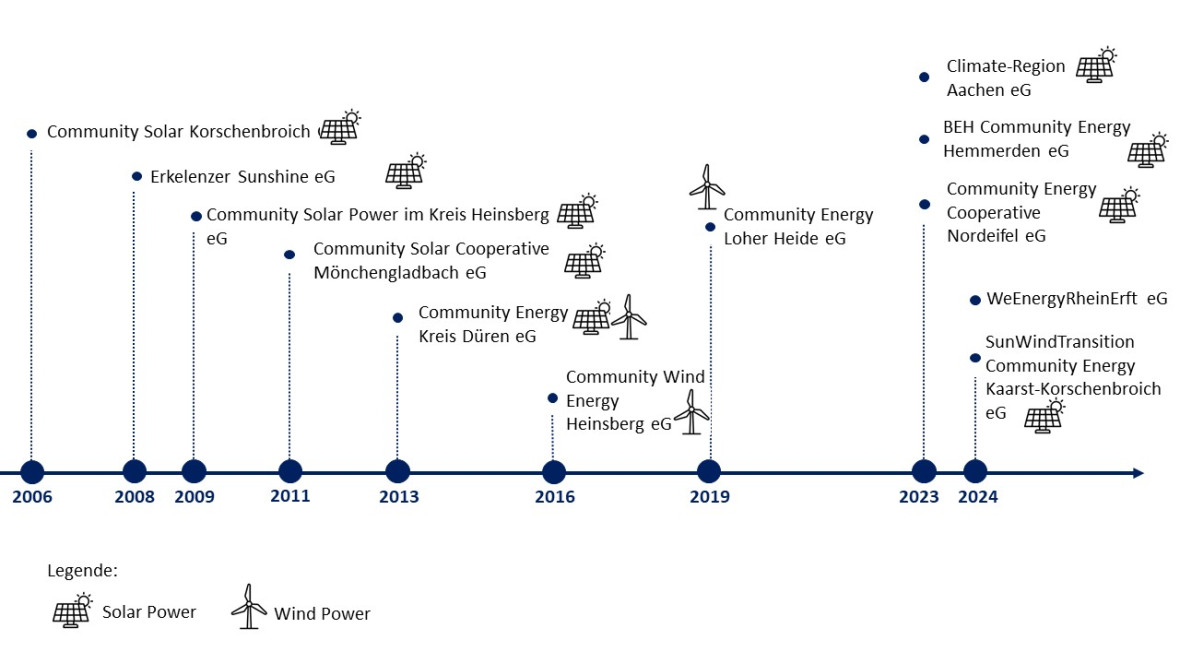
Regional differences: urban versus rural mining regions
For the study, Dolinga compared two regions that face the same challenge of phasing out coal but differ in structure. The Rhineland mining area is more densely populated and urban in character, while Lusatia is a sprawling rural region. These and other differences shape how community energy projects emerge and which obstacles they have to overcome.
To understand these dynamics, Dolinga uses an ‘innovation systems’ approach, which examines the factors that promote or block an innovation – in this case, community energy. Key factors in her analysis include:
- Knowledge: Is there enough technical and organizational know-how locally?
- Policy: Are the legal framework and societal attitudes supportive?
- Resources: Can enough people be mobilized to join community energy projects? Can funding and land for installations be secured?
- Legitimacy: Do people in the region see community energy as worthwhile and desirable?
Critical resources: funding, land and people
Three resources are crucial for a community energy project: capital, land and people. A project needs a critical mass of members, both to secure its financial base and to provide the labour needed to run it. Because setting up and running an energy cooperative takes a lot of time, many initiatives depend on a small number of highly committed individuals. Without this core of volunteers, projects can fail before they get off the ground.
Financing new installations can also be a challenge for community energy initiatives. At present, the uncertain future of the Renewable Energy Sources Act (EEG), and with it the statutory feed-in tariff, is making it particularly difficult to plan new installations.
In densely populated areas such as the Rhineland mining area, finding suitable sites for new installations is often a further challenge. Partnerships with local authorities or businesses can help.
Rooted in the community
In the regions studied, community energy projects rarely meet local opposition – and their local roots play a decisive role in this. Their members know the area: which sites may be unsuitable for installations, and where earlier disputes over installations have arisen. They are often well connected, know key people in local government and civil society, and can rally broad support. This allows them to develop projects that put regional benefits first – for example, supplying a municipality with low-cost electricity from solar panels on a school roof.
Even so, community energy does not resolve every conflict. Negotiating exactly where installations should go often remains complex and requires transparent communication to gain social legitimacy. “Community energy is a social innovation. It is not just about the technology, but about how people find new ways of acting and organizing together,” says Dolinga. “We see that there is no one-size-fits-all model. The solutions have to be as specific as the regions themselves.”
Methodology and project details
The RIFS Study draws on quantitative data and qualitative interviews with regional stakeholders. The study is part of the transdisciplinary project CREATE:ENERGY (2025–2027), which is coordinated by the Brandenburg University of Technology Cottbus-Senftenberg (BTU) and led jointly with RWTH Aachen University. The project is funded by the Federal Ministry for the Environment and Stiftung Mercator. RIFS is responsible for the comparative analysis of the mining regions and for research accompanying the project.
Publication:
Dolinga, S. N. (2026). Bürgerenergie in Strukturwandelregionen: Analyse der sozialen Innovationssysteme „Bürgerenergie“ im Rheinischen Revier und der Lausitz [Community energy in regions undergoing structural change: An analysis of community energy as a social innovation system in the Rhineland mining area and Lusatia] (RIFS Study). https://doi.org/10.48481/rifs.2026.025