Acceptance of Wind Energy: Political Orientation More Important than Urban-Rural Divide
05.10.2026
Attitudes towards the expansion of wind energy vary significantly according to people’s political orientation. Whether people live in urban or rural areas, however, plays only a minor role. A research paper published in the journal Energy Policy shows that trust, accessible and comprehensible information, and procedures perceived as fair are particularly important when it comes to planning decisions.
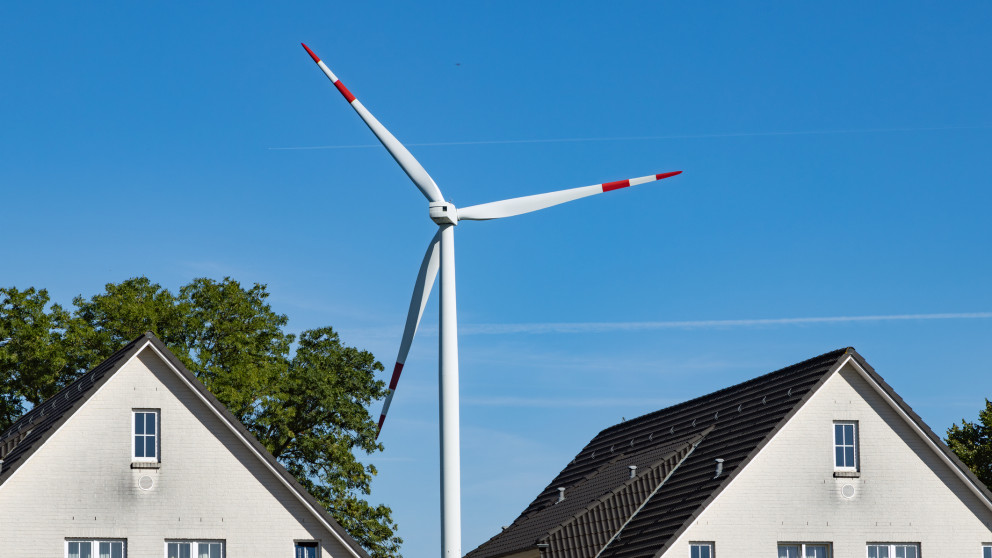
Why does the expansion of wind energy sometimes meet with local resistance, even though renewable energies generally enjoy broad support? RIFS researcher Jörg Radtke used a representative survey of 6 284 people in North Rhine-Westphalia to investigate which social characteristics are linked to the acceptance of wind energy.
The key finding: political orientation is significantly more closely linked to attitudes towards wind energy than place of residence. The frequently assumed urban–rural divide proves to be comparatively weak in the statistical analyses.
This is particularly evident in people’s support for expanding wind energy in their own district. Respondents who do not intend to vote for the AfD score around 3.6 on a scale of one to five in both rural and urban areas. Among respondents intending to vote for the AfD, however, the scores are around 1.5 in both rural and urban settings. The differences between urban and rural areas within the same political group are minor. Even when other social characteristics are taken into account, political orientation shows by far the strongest structural correlation with local acceptance of wind energy.
“Our findings contradict the notion that conflicts over wind energy can be explained primarily by a divide between urban and rural areas,” says Jörg Radtke. “More decisive are the political orientations, relationships of trust and notions of fair procedures through which people assess specific wind energy projects.”
Trust and fair procedures are key
However, political differences are not the only relevant factor. Trust in independent science, planning authorities, politicians and the media, as well as other public institutions, and the perception of fair procedures and transparent siting decisions are closely linked to support for wind energy. If such project-related factors are included in the statistical models, a significantly larger part of the differences in local support can be explained.
“A fair process cannot be reduced to a single instrument,” explains Radtke. “What matters is transparent decision-making on where projects are sited, opportunities for early public involvement and clearly defined benefits for local communities. Financial participation can be one component, but it should be embedded within a broader, credible process.”
Despite differing political outlooks, citizens tend to have similar information needs. Respondents from various groups would, above all, like to know – before wind turbines are built – what levels of noise pollution can be expected, where exactly they will be erected, what impacts there will be on nature and the environment, and what protective measures are planned.
More distinct differences appear when it comes to the question of whom people trust and how conflicts should be decided. Respondents who do not intend to vote for the AfD are more likely to cite the scientific community and environmental organisations as trustworthy sources of information. Respondents intending to vote for the AfD generally show less trust in institutional actors and, in the event of conflicts, are more likely to favour binding procedures such as referendums. Political actors and wind energy companies are, on the whole, cited significantly less frequently as trustworthy sources of information.
No one-size-fits-all strategy for participation
The findings provide concrete guidance for the planning of wind energy projects. Rather than basing public engagement and communication solely on whether a project is being developed in an urban or rural area, greater account should be taken of differing levels of trust and preferences regarding public engagement.
Among other things, the paper recommends transparent site selection criteria, clearly defined community revenue-sharing models, and the supply of information from credible, as independent as possible, actors. With regard to public engagement, the findings suggest a combination of in-person events and complementary digital offerings. Face-to-face formats are valued across all the groups studied, while openness towards digital and visualization-based offerings varies more strongly.
“Issues of acceptance should not be addressed only after a conflict has arisen,” says Radtke. “Transparent rules, credible information and fair opportunities for participation are essential to ensuring that the necessary expansion of wind energy is socially sustainable.”
The paper underscores that the social conditions in which new energy infrastructures are implemented – the quality of local governance, the comprehensibility of decisions and the handling of distributional and procedural questions – are just as important as the technical and administrative side of efforts to accelerate the growth of wind energy.
Publication:
Radtke, J. (2026). Gaps in mind: Political and spatial cleavages in local onshore wind attitudes in Germany. Energy Policy, Article 115475. https://doi.org/10.1016/j.enpol.2026.115475
Contact