Thinking about the world from its end: Finding hope in a changing climate
05.01.2026
“Please state your name and area of work, and tell us how you would like to die – if you’re comfortable sharing, of course,” asks dramaturge Christian Tschirner. Twelve of us are sitting in one of the final sessions of the 2025 RIFS Conference Tough Conversations in Tough Times in Berlin. The conference focused on the backlash against sustainability transitions, and over two days, we discussed societal polarisation, consumer behaviour, resistance to climate action, the erosion of democracy, and opportunities for citizen participation in the energy transition.
In the workshop "Telling the story from the end: Introducing the concept of palliative dramaturgy," we weren't just prepared to answer Tschirner’s question – we were genuinely grateful to do so. Our responses went beyond simply explaining how we would like to die. We shared stories of personal loss, how we cope with death, and the fears we associate with climate change. This created a space where we could combine scientific debate with our personal emotions, fostering mutual understanding and openness to navigate these difficult issues together.
This blog post is part of a series on the 2025 RIFS Conference "Tough Conversations in Tough Times".
Palliative dramaturgy creates new narratives
So what is palliative dramaturgy? It translates experiences of caring for the dying and mourning into social narratives and asks a powerful question: is our experience of the world a melodrama, a comedy, a tragedy, or perhaps a grotesque? According to Luke Kemp from Cambridge University, a global collapse – driven by growing inequality, disruptive technologies, and narcissistic elites – is not unlikely. Yet, we find it incredibly difficult to acknowledge the reality of the climate catastrophe. One reason may be that Western societies tend to externalise death, failing to see it as an integral part of life – leading to a belief in endless progress and infinite growth.
Palliative dramaturgy reintroduces death into the narrative of social change. Psychiatrist Elisabeth Kübler-Ross argued that confronting death is about accepting the inevitable without succumbing to despair. Through acceptance,rather than repression or panic, we can regain our ability to act and make decisions. The five stages of death or mourning – denial, anger, bargaining, depression, and acceptance – can serve as a guide, though they aren’t necessarily linear and can occur simultaneously or cyclically. While this widely cited model is often debated and may not fully capture individual experiences, it can still provide a framework for addressing climate change at a societal level.
Building on this, palliative dramaturgy proposes that we engage in the work of caring for a dying planet and achieve a broader acceptance of the possibility of a global catastrophe. Palliative care, derived from the Latin palliare, meaning “to wrap” and “to protect”, describes holistic care for those who are dying. What can we learn from these practices and apply to the care of the planet? For instance, what do we want to preserve? What do we want to change? And what does solidarity mean in these times? Kemp indeed suggests that while he is pessimistic about the future, he remains optimistic about people.
Palliative dramaturgy for science?
These are stimulating questions that encourage participants to grapple with their emotions, fears, and personal struggles concerning the climate crisis. Thinking about death and sustainability together could also help reach groups that are strongly opposed to climate protection, as death – in the sense of radical universalism – is something that unites us all.
We can also view the five stages of death as an analytical model to understand how people behave and position themselves in the face of the climate crisis. Climate change denial speaks for itself. Anger, on the other hand, manifests in resistance to heating regulations and rage against climate activists. The idea of tackling climate change with new technologies could also be seen as an attempt to negotiate – to buy the planet a little more time.
Play and optimism
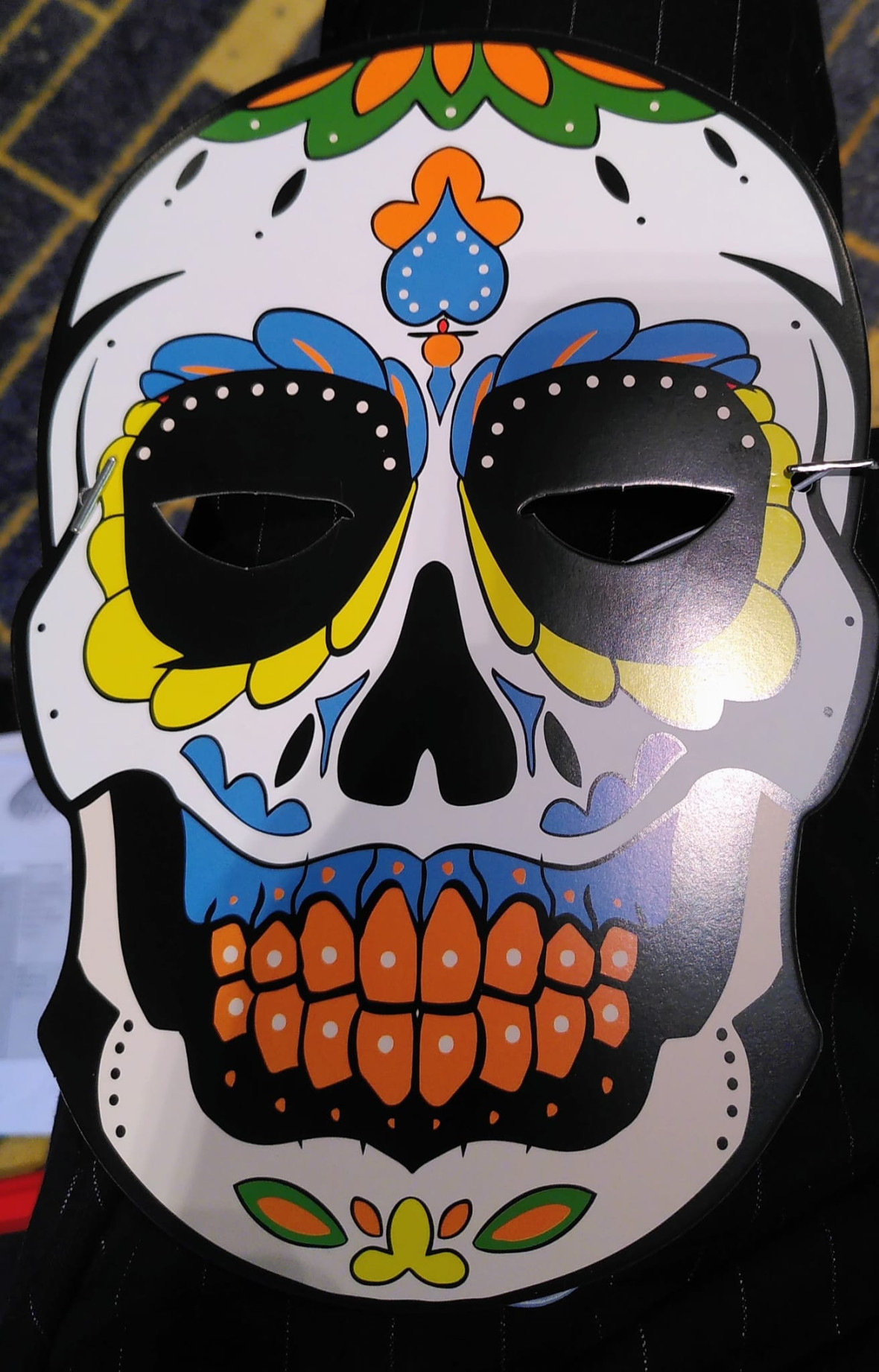
In the workshop, we enacted this negotiation through a role play. We paired up. One person played death, complete with a death mask, while the other attempted to negotiate, pleading, using cunning, and making arguments to secure a little more time for themselves and the planet. There were no winners or losers – just as the battle against climate change remains undecided – but we had a lot of fun.
During the closing plenary session of the conference, the moderator asked for final thoughts. A woman stood up. She worked for a mobility transition initiative and had been hesitant about coming to the conference, feeling rather pessimistic. But now, she was travelling home with renewed optimism, largely due to the workshop on palliative dramaturgy. The open dialogue and the feeling of collectively facing the crisis in our society had given her a renewed sense of strength.
This blog post was created with the support of Katharina Beste.