Academic extractivism – How are we fostering ongoing colonial relations with(in) our institutions?
19.12.2025


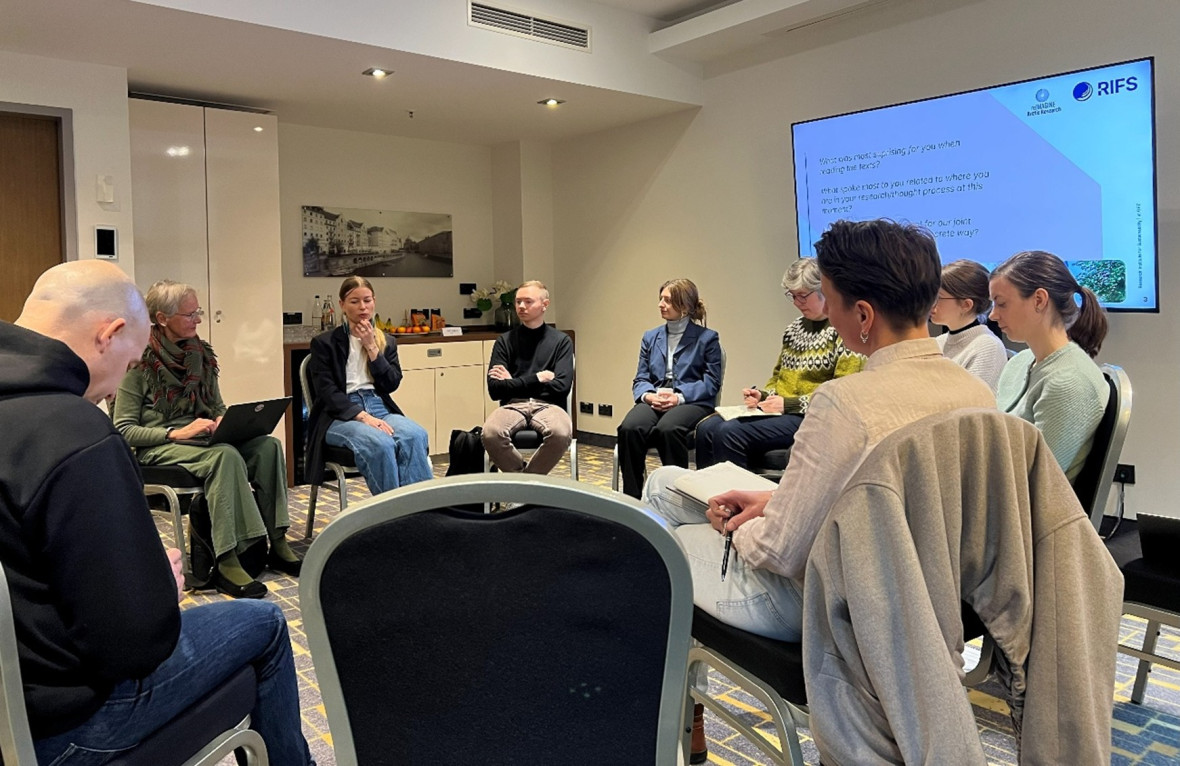
Before the RIFS Conference on December 3 in Berlin, the reIMAGINE Arctic Research group and affiliated scholars held a workshop titled “Conversations in Tough Times on Arctic Research.” The workshop explored academic extractivism, decolonialisation, and sustainability, and how these issues intersect in Arctic research.
Where do you come from right now, reading this blog post? Close your eyes and imagine home. Which places or people do you think of first? Keep that image in mind – we will return to it later.
During the workshop, we used this exercise as an introduction before sharing reflections on two texts. The first text is a forthcoming article by Naja Dyrendom Graugaard (Associate Professor, Copenhagen University & RIFS Research Associate) and Vivi Vold (Researcher at UiT) on Inuit experiences of what they define as “academic extractivism in Arctic research.” The second text was the introduction to “The Undercommons – Fugitive Planning & Black Study” by Stefano Harney and Fred Moten, suggested by RIFS Research Fellow Saskia de Wildt.
We reflected on three guiding questions:
- What was most surprising for you when reading the texts?
- What spoke most to you related to where you are in your research/thought process at this moment?
- How are these texts relevant for our joint projects/collaborations in a concrete way?
Other questions emerged during the workshop. Finding answers was sometimes difficult. Nevertheless, we would like to share some of our thoughts and conclusions.
Academic extractivism
“A research process that approaches the knowledge and experiences of Indigenous, racialized, gendered, and other marginalized peoples as something to be extracted, used, appropriated, and sometimes exploited.” – Graugaard & Vold, 2025, p.2 (forthcoming)
In their article, Graugaard & Vold elaborate on the work by Nishnaabeg scholar Leanne Betasamosake Simpson: “Extracting is stealing - it is taking without consent, without thought, care or even knowledge of the impacts that extraction has on the other living things in that environment.” (Simpson, 2017).
Positionality
Returning to the “home exercise”, we asked ourselves: Where do you come from within academia? What positionality do you bring into your work? Honest reflection on these questions is essential for understanding colonial relations.
The reIMAGINE Arctic group is part of the Research Institute for Sustainability (RIFS) in Germany and consists of scholars from outside the Arctic. This raises an important question: What motivates researchers with non-Arctic backgrounds to work in Arctic contexts?
Questioning the academic system can lead to a sense of disconnection. Researchers may realize they are part of structures that perpetuate colonial, racial, and gendered injustices – a realization that can feel uncomfortable or even threatening.
“Am I the right person, as a male, white scholar, to do Arctic research?” – Torben Windirsch (RIFS Research Fellow)
The innocence of data
Data collection is often portrayed as neutral and objective, but choices made in research – what to measure, when, where, and what to publish – are deeply influenced by human intentions.
We discussed how this supposed neutrality and objectivity in some areas of research is linked to the belief that the facts and data on which research relies – and which it produces – are inherently innocent and incapable of causing harm. The problem with this way of thinking is that data as a form of knowledge is always linked to social relations. As Naja Dyrendom Graugaard and Vivi Vold explain in their forthcoming article, they as Indigenous researchers are frequently asked to provide their knowledge for projects with no reflection of reciprocity.
“The request to “pick my brain” also often entails the request to “pick” my relations, my connections, and my community - on the premise to build up the work of the person who made the request, but with no articulated consideration of how this connection may benefit the people whose contacts I am asked to share.”
– Naja Dyrendom Graugaard in Graugaard & Vold, 2025, p.9 (forthcoming).
It is therefore crucial to recognise that knowledge is never produced or exchanged outside social and power relations and, as such, always carries the potential to cause harm.
Of rebellion and refusal
Drawing on "The Undercommons", we discussed the difficulty of navigating systems that often present only the “lesser of two evils” (Evie Morin, research associate at RIFS). Refusal – declining extractivist requests that do not include meaningful collaboration – can create new possibilities outside entrenched academic structures. For Indigenous researchers, refusal can also mean identifying and declining extractivist requests, for instance, from people who have no interest in cooperating to shape processes and outcomes together.
But when should refusal begin? Time constraints in the application process for project funding make it incredibly difficult to follow a co-creative approach from the outset. Further funding and delivery constraints during the project can also make it difficult to build lasting relationships. Rebellion is not only about saying no; it also means envisioning futures beyond the immediate limitations imposed by contracts and colonial legacies.
Sharing knowledge
Finally, we discussed methods of sharing knowledge across different areas of research. How can spaces for conversation, like our circle at the workshop, be multiplied? What protects radical and wild spaces from being taken over by a system and unintentionally framed into capitalistically exploitable, measurable and evaluable formats? Some of the solutions we see: In the social sciences, artistic forms of sharing knowledge can be used, articles can be written as conversations, narratives and images can matter as much as written knowledge. In natural sciences, these methods and Indigenous approaches to research are often perceived as challenging traditional notions of “professionalism,” because they do not align with conventional evaluative criteria.
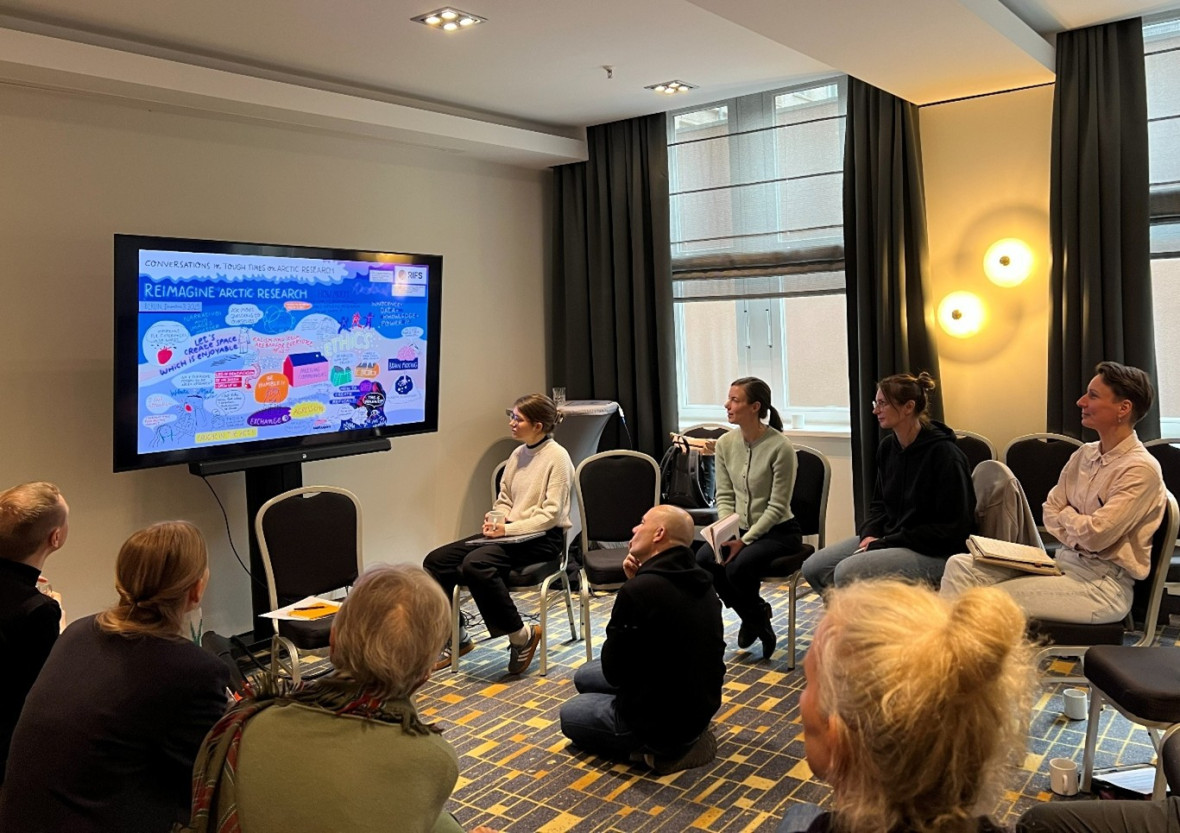
In the last part of our workshop, we were able to examine the graphic recording made by Berlin artist Susanne Asheuer (see top). This form of presenting knowledge not only preserved the nature of our conversations, but also opened up a space for evaluation.
The reIMAGINE Arctic research group thanks all affiliated artists and scholars for their participation in the workshop. We look forward to continuing to learn together as we work towards more decolonial and non-extractive research practices in the Arctic.