Leadership Challenges at COPs: Between Care and Despair
19.11.2026
This blog was jointly developed by Thomas Bruhn, Thomas Kühn, and Jeremy Dommnich. It is written from Thomas Bruhn’s personal perspective, while drawing on shared research, conversations, and reflections among the three authors.
Why do we still come together?
This question has – once again – been on my mind during the past days at COP. After more than three decades of international climate negotiations, with global emissions still far from the trajectories needed to avoid dangerous climate change, it seems legitimate to ask: Why do we keep organizing these enormous gatherings? What is their actual contribution to addressing the climate crisis? And what happens here that could not happen elsewhere?
Yesterday, in a conversation with two colleagues, we found ourselves approaching these questions from an unexpected angle. Over the past years, we have interviewed numerous people involved in the international climate negotiations, exploring their experiences of leadership, responsibility, and agency. What emerges is a deeply paradoxical picture. Many negotiators understand themselves as exercising leadership, yet struggle to identify where they can actually make a difference. They carry significant responsibilities while operating within highly structured processes that leave remarkably little room for individual agency.
And yet, they keep coming back.
One of my colleagues shared a seemingly simple observation: There are few places in the world where it is as easy as at a COP to approach strangers from literally all parts of our planet and engage in meaningful conversations. This made us wonder why.
The assumption of care
Perhaps it has something to do with an underlying assumption that we rarely make explicit: The person standing in front of me is here because they care. They care about climate change, about the future of our planet, about something that extends beyond their immediate personal interests.
People come to COPs for many different reasons. Political and economic interests, professional ambitions, and institutional obligations all play their part. And caring about the climate does not necessarily mean agreeing on what should be done about it. Yet there is something remarkable about being able to approach another person with the assumption that, at some level, we share a concern for the larger whole. Whether people at COP are indeed more strongly motivated by such a concern than in other settings remains an empirical question. For now, this assumption emerges from our interviews and personal experiences. Yet I am increasingly curious about what becomes possible when we consciously choose to approach one another in this way.
I find this particularly remarkable against the backdrop of what is often described as an increasingly polarized and confrontational public discourse. Here at COP, people from virtually every part of the world, shaped by profoundly different cultural traditions, political systems, historical experiences, and ways of understanding the world, find themselves sharing the same physical space. And despite these profound differences, our experience confirms a starting point for our encounters of something like: “Before I know what divides us, I can approach you with the possibility that there is something we both care about.”
I wonder whether I or we sufficiently appreciate the significance of this.
The tensions of caring
In our interviews, we have encountered a deeply paradoxical picture of the tensions involved in participating in these negotiations. Many negotiators entered their professional lives because they genuinely care about global challenges such as climate change or peace. Yet as public servants, they are committed to representing national interests, operating within political mandates and highly structured negotiation processes. These commitments can create profound inner tensions. Some of our interviewees explicitly described how they cope through compartmentalization: keeping different parts of their professional and personal identities separate in order to remain functional within the process. One interviewee even shared that she routinely schedules additional therapy sessions before and after COPs to help her navigate the emotional and psychological tensions involved. Many also experience considerable exhaustion. Long working days, sleep deprivation, emotional pressure, and the recurring frustration of investing enormous effort into outcomes that often seem painfully insufficient.
And still, they return.
Our interviewees consistently emphasize how much importance they attach to this process, despite all its dysfunctions and slowness. Behind the official positions and institutional roles are people who continue to engage with a process that can be profoundly frustrating, yet that they consider indispensable. I find this deeply moving.
The paradox of coming together
What if COPs bring together an extraordinary concentration of people who genuinely care about our shared future, while organizing their encounters predominantly through structures that emphasize competition, representation, and difference?
International negotiations necessarily involve conflicting interests, and national delegates are accountable to their governments and constituencies. At the same time, I see a troubling contradiction in how strongly these dynamics shape the way we encounter one another.
Walking through the conference venue, I am often reminded of Erich Fromm’s distinction between having and being. So much of what happens here seems shaped by the need to represent, demonstrate, perform, and achieve. Panels, exhibitions, and countless events become stages for presenting positions, institutions, accomplishments, and ourselves. I certainly recognize these tendencies in my own engagement with COPs.
Over the past years, I have often found myself frustrated by these dynamics, trying to offer alternative forms of encounter through initiatives such as the Co-Creative Reflection and Dialogue Space. This year, however, something feels different to me. Perhaps I am less interested in trying to change what I see and more interested in witnessing it. In recognizing the struggles of the people who keep engaging in this process, despite its limitations and contradictions. In appreciating the care that may lie beneath the institutional roles, political performances, and sometimes frustrating dynamics. The dysfunctions remain deeply troubling. But they are not the whole story.
The magic of the in-between
One of our interviewees, an experienced negotiator from Middle America, emphasized something that has stayed with me: Whatever its shortcomings, this process must continue. The formal negotiations provide a shared point of reference for an extraordinary global gathering. They attract political attention, create a sense of significance, and bring together people and organizations who might otherwise never encounter one another. In a way, the negotiation process serves as a global campfire around which people from across the planet gather. Its significance extends far beyond what can be captured in a final negotiation text.
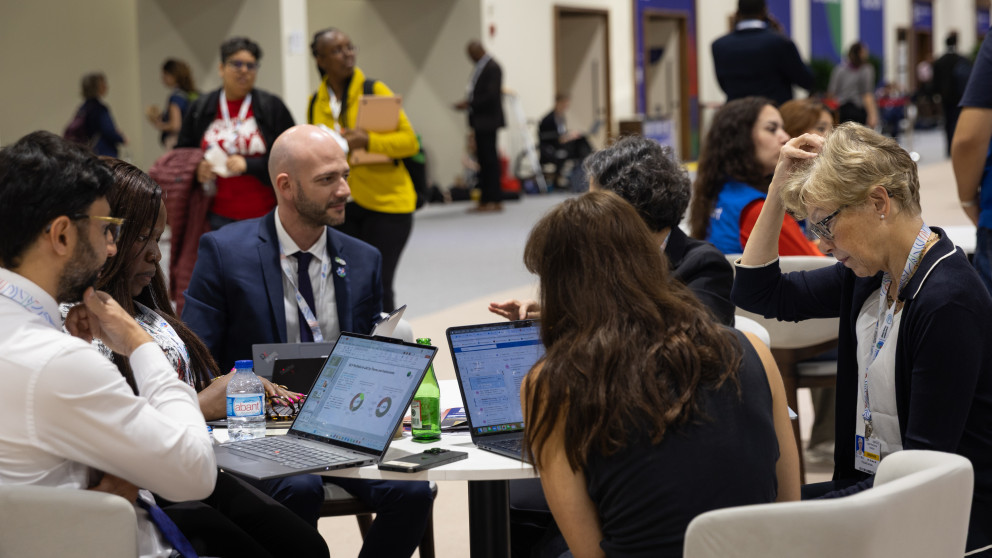
And one striking observation appears consistently across our interviews: Much of what people experience as most meaningful happens outside the formal negotiations. In informal meetings, over dinner, in corridors, during coffee breaks, or in unexpected conversations with people they might otherwise never encounter. These are moments in which relationships develop, trust emerges, and people begin to understand one another beyond their official positions. Our interviewees repeatedly describe how much they value these opportunities to connect, learn from one another, and build relationships across national and cultural boundaries.
At the same time, our previous research has shown how informal spaces can also reproduce hierarchies, competition, exclusion, and regressive group dynamics. The pressures of highly regulated institutional environments do not simply disappear when people step outside the negotiation rooms. The informal spaces themselves are shaped by the wider institutional culture.
I find this tension particularly interesting. The formal negotiations create the conditions that bring people together, while some of the most valuable experiences emerge in the spaces between them. The quality of these encounters, however, cannot be taken for granted. Maybe we have become so focused on organizing the formal processes that we pay insufficient attention to the conditions under which meaningful human encounters can unfold.
What makes human gatherings irreplaceable?
This question becomes particularly interesting at a time when artificial intelligence is beginning to transform how we process information, analyze texts, and support complex decision-making. As more of the analytical and procedural work involved in international negotiations can be technologically supported, I believe we need to ask more explicitly what makes physical human gatherings valuable in the first place. What is “the magic” that can only happen because real humans from across the planet come together for two weeks?
I do not think the answer lies simply in exchanging information or reaching agreements. It also lies in the unpredictable possibilities of human encounter. In meeting someone whose worldview is profoundly different from our own, yet discovering a shared concern. In the emergence of trust where there was previously distance. In moments when institutional roles become less dominant and we recognize one another as fellow human beings. Much of the actual transformation of our societies will necessarily happen elsewhere. But these decentralized transformations may also need moments of global gathering, in which we experience ourselves as part of something larger and encounter others who are making their own efforts to address our shared challenges.
I keep returning to the question of why we continue to organize these extraordinary gatherings. The more I listen to the people who keep returning to these negotiations, the more I appreciate the struggles they are willing to endure for something they deeply care about. And to me, this appreciation offers a different starting point for our own encounters.
What if, in our next conversation with a stranger at COP, we consciously approached them with the assumption that they, too, care deeply about something larger than themselves? That they, too, may be struggling with the tensions between their personal convictions, institutional responsibilities, and the frustrating limitations of collective action?
I wonder what might become possible if we allowed this assumption to shape more of our encounters. Maybe that is where some of the magic of coming together as real humans begins.
Contact